Institutional control before digital systems act.
immo.quick connects institutional authority, applicable rules and verifiable evidence. The Serverless Edition controls execution rights before protected effects; Core makes the context of institutional determinations traceable.
A login establishes identity; it does not determine whether a payment, data release or agent action is permitted now. immo.quick addresses that control question and binds each protected decision to its governing state and a traceable record.

Why access alone is not enough.
Conventional IT and security systems remain essential. IAM checks identity and access, workflows coordinate processes, SIEM detects anomalies, risk engines assess risk and audit logs document events. These systems solve different problems.
immo.quick operates at the execution boundary. It evaluates whether authority, applicable rules, jurisdiction, time and required dependencies jointly form a valid execution state for the specific action. A technical PASS at a single point does not replace this closure.
Two independent systems. Distinct responsibilities.
immo.quick Core and the immo.quick Serverless Edition are not two views of the same system. They address different technical requirements and are therefore deliberately explained and operated separately.
Software-native execution and evidence infrastructure
The Serverless Edition connects to existing systems, applications, platforms, workflows and AI agents. Before protected effect, it evaluates whether the current execution state is complete and binds the decision to verifiable evidence.
- API / Workflow / Event
- AI / Agent Interlock
- Jurisdiction + Rule State
- Receipt / Evidence
Hardware-based trust boundary
Core addresses highly sensitive execution environments with hardware-backed trust boundaries. TEE, enclaves, HSM-based key structures and attestation are used to isolate execution and key material even from parts of the surrounding infrastructure.
- TEE / Enclaves
- HSM-backed keys
- Attestation
- Sensitive execution environments
Integrate the control boundary into existing systems.
The integration method may vary. The decision and evidence semantics must not. API, event, workflow, agent, controlled offline transfer or hybrid operation are different transport and integration patterns for the same institutional control question.
Implementation begins by defining which actions actually require protection. Authority sources, internal and external data, relevant jurisdictions and rule domains are then mapped. Only then is the technical control boundary connected to the actual Point of Effect and validated with positive and adversarial negative tests.
Governance in the context of your sector.
Each sector has its own regulatory, operational and technical requirements. Relevant gates, legal rules and data sources are therefore explained within the sector context rather than as an isolated gate catalogue.
Banking & Capital Markets
Payments, treasury, AML/KYC, sanctions, market integrity, MiCA, liquidity and regulatory Execution Rights.
Public Sector
Public authority, procurement, subsidies, digital administrative acts and demonstrable authority.
Defence
Export controls, procurement, transfer, classified environments and cross-jurisdictional Execution Conditions.
Pharma & Clinical Trials
Study states, approvals, data integrity, regulatory dependencies and forensic evidence.
Energy & ESG
Grids, resilience, EU Taxonomy, sustainability rules and regulatory evidence.
All Sectors
Healthcare, aviation, logistics, real estate, AgriFood, sport, digital markets, telecom and further institutional domains.
Resolve jurisdictions and rules in context.
immo.quick does not treat jurisdiction as a static country field. Rules can overlap or conflict. Such collisions are not silently averaged away; they become explicit states and are routed into a defined governance path.
Collision screening
National + EU context
Cross-border checks
Context-dependent activation
Trace decisions. Inspect the evidence.
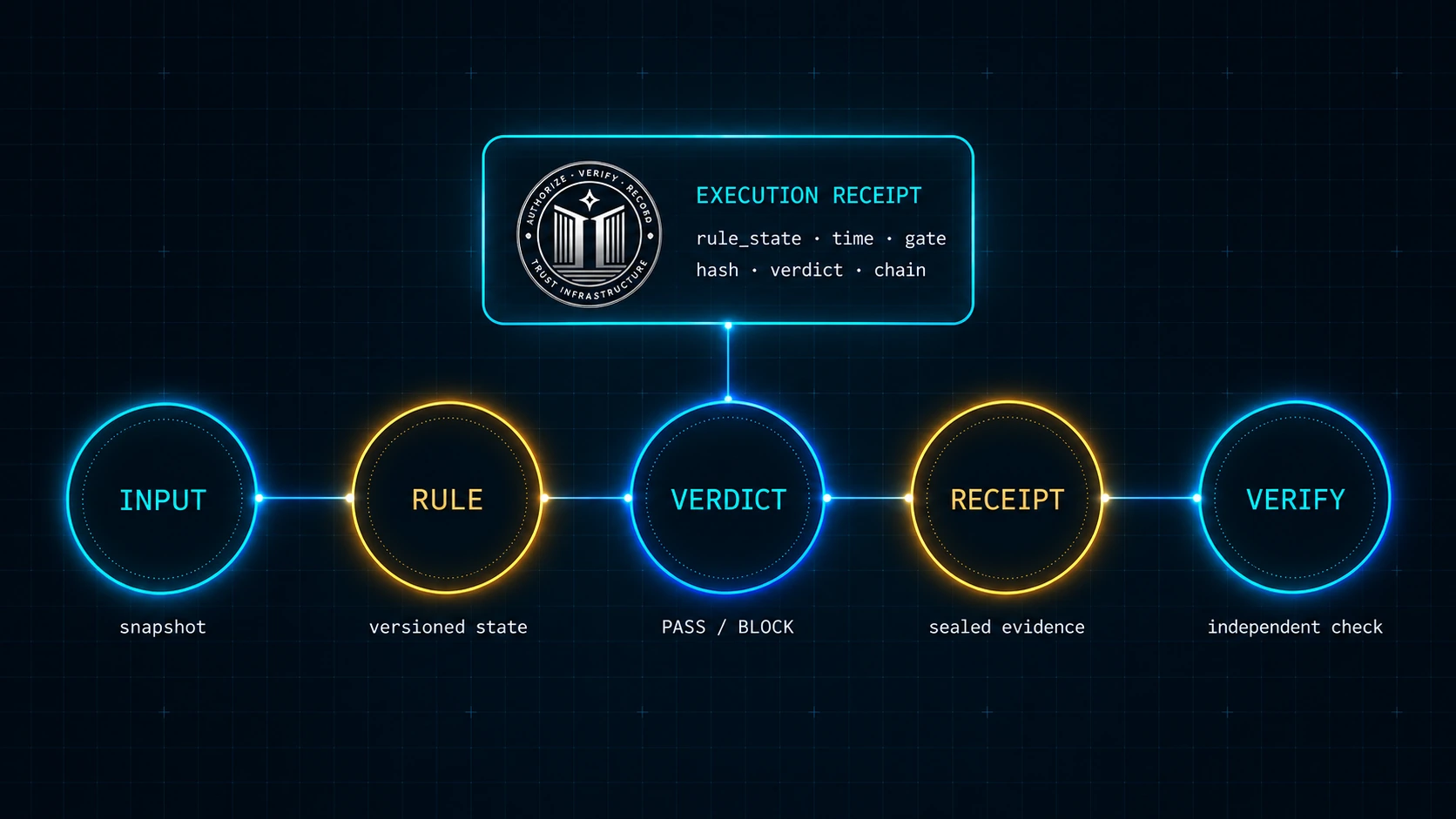
Receipts are the public evidence anchor of the site. They can document which input was processed, which rule state was active, which gate results were produced and how the result was cryptographically bound.
The limits matter just as much: cryptographic integrity is not automatically substantive legal correctness, truth of every external source or a guarantee of judicial acceptance. Those boundaries remain explicit.
Assess the architecture for your institutional mandate.
The world is moving from software that supports decisions toward infrastructure that controls whether digital effects may occur at all. immo.quick addresses this institutional control boundary with two independent systems, sector-specific rule architecture and verifiable evidence.