Quantum computing is not a single threat, it is two separate algorithms with fundamentally different effects, against fundamentally different cryptography. This page goes deeper than the general cybersecurity overview and shows exactly which algorithm affects which part of our architecture, and which does not.
A classical bit is either 0 or 1. A qubit can hold both states at once, a superposition, and multiple qubits can be entangled so that the state of one depends on the other. This lets certain algorithms search a vast solution space in parallel instead of sequentially.
This distinction is the core of the entire defence logic, so it comes first, before the architecture itself is explained.
A quantum computer attacks the classical signature and the symmetric chain integrity in two completely different ways. The post-quantum signature is untouched by either attack. A receipt only fails once all relevant layers fail simultaneously, not when a single one is weakened.
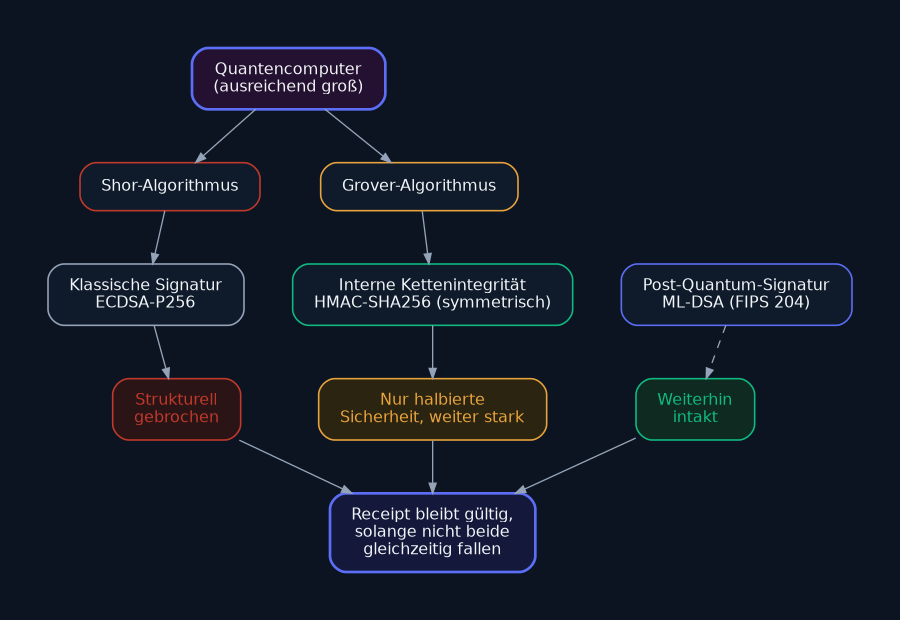
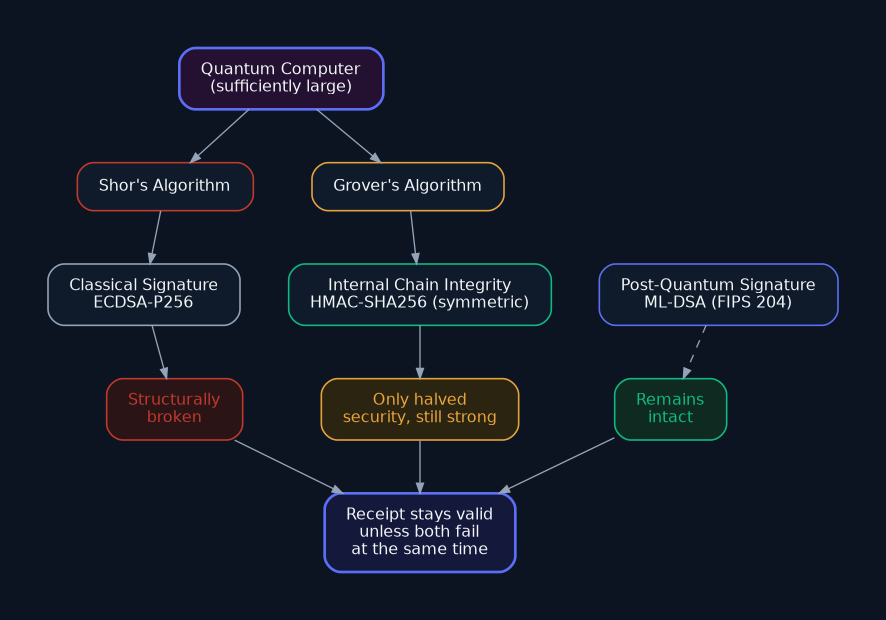
Concept illustration, not a proof of unbreakability