SHA-384 · SHA-2 · NIST FIPS 180-4
SHA-384: standardized and in production in the receipt chain
The immo.quick Serverless Edition uses SHA-384 for hashing and receipt chaining. Production use is confirmed by the publisher. This implements a published cryptographic standard as a deliberate architectural choice, without waiting for a general cross-sector SHA-384 mandate.
SHA-384 is a standardized hash function with a 384-bit output. Here it binds integrity. It is neither encryption nor a digital signature. In the published system profile, HMAC-SHA-256, the Ed25519 and ML-DSA-87 receipt signatures, and the additional SLH-DSA daily-root signature remain distinct protective mechanisms.
What the standards actually require
- The cited standards do not establish a universal requirement for all banks, businesses or critical infrastructure applications. Requirements depend on the specific use, security profile and applicable rules.
- TLS 1.3: RFC 8446 explicitly distinguishes MUST for TLS_AES_128_GCM_SHA256 from SHOULD for TLS_AES_256_GCM_SHA384. SHA-384 is therefore not universally mandatory for TLS 1.3. Receipt chaining must also be distinguished from the negotiated TLS connection.
- High-security profiles: CNSA requirements address defined US national security applications. SHA-384 has a specific role within those profiles. This does not create a general obligation for every European business.
- Standardized means the algorithm is publicly specified. It does not mean our implementation is certified by NIST, BSI or NSA. SHA-384 alone does not make an entire system post-quantum secure.
Primary sources and technical context: NIST FIPS 180-4 · RFC 8446 §9.1 · NSA CSfC / CNSA
Operating-state statement: publisher confirmation dated 3 November 2026. This page describes production use; auditing the running backend is outside this website update.
Two algorithms, two completely different threats.
Quantum computing is not a single threat, it is two separate algorithms with fundamentally different effects, against fundamentally different cryptography. This page goes deeper than the general cybersecurity overview and shows exactly which algorithm affects which part of our architecture, and which does not.
What structurally makes a quantum computer different.
A classical bit is either 0 or 1. A qubit can hold both states at once, a superposition, and multiple qubits can be entangled so that the state of one depends on the other. This lets certain algorithms search a vast solution space in parallel instead of sequentially.
Shor breaks structure. Grover speeds up search.
This distinction is the core™ of the entire defence logic, so it comes first, before the architecture itself is explained.
Why a receipt stays valid, even if an attacker owns a quantum computer.
A quantum computer attacks the classical signature and the symmetric chain integrity in two completely different ways. The post-quantum signature is untouched by either attack. A receipt only fails once all relevant layers fail simultaneously, not when a single one is weakened.
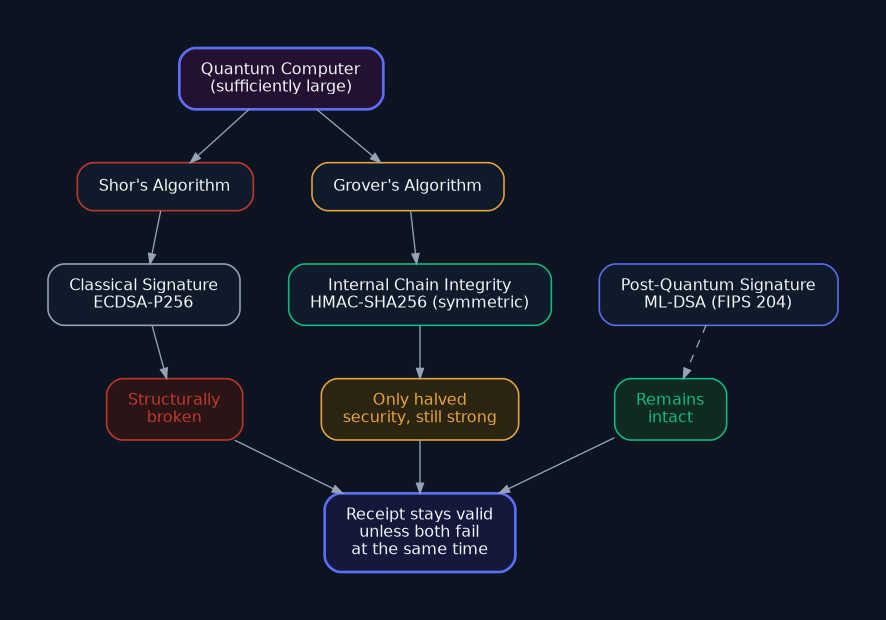
Concept illustration, not a proof of unbreakability
Are we quantum safe? Yes, with one reservation.
ML-DSA-87 (FIPS 204) runs at NIST security level 5, comparable to AES-256, alongside the classical Ed25519 signature. A receipt is valid only if both signatures verify. A forgery is therefore detected as long as one of the two schemes holds. Daily roots additionally carry the hash-based scheme SLH-DSA-SHA2-256s (FIPS 205). Signing keys are generated locally on the own server and never leave it.
The reservation: ML-DSA is a comparatively young standard, standardisation is considered complete, but younger methods naturally have a shorter attack history than RSA or ECC. That is exactly why the hybrid combination is the more cautious choice, not a superfluous one, the probability that both methods fall at the same time is negligible.
What is real, what is speculation, what is regulatory.
What this page does not claim.
- No claim that a break of the lattice-based methods is excluded. ML-KEM and ML-DSA have been final since August 2024, younger than RSA and ECC, the hybrid combination is therefore the more cautious choice, not a superfluous one.
- No claim that a cryptographically relevant quantum computer exists today. The architecture is designed against harvest-now-decrypt-later, a risk already running independent of today's state of the machine.
- Not a replacement for the general cybersecurity overview. This page deepens only the cryptographic part, it does not replace access control, network security, or organisational diligence.