Language:
PRODUCTS
MORE
Quantum Security 🔍 Search Request Access →
gateMarketAbuse — Market Abuse Execution Gate
// IMMO.QUICK · GATEMARKETABUSE · GATE 23 · MIFID II ART. 17/RTS 6 · MAR · BMR 2016/1011

A manipulated order never reaches the order book.

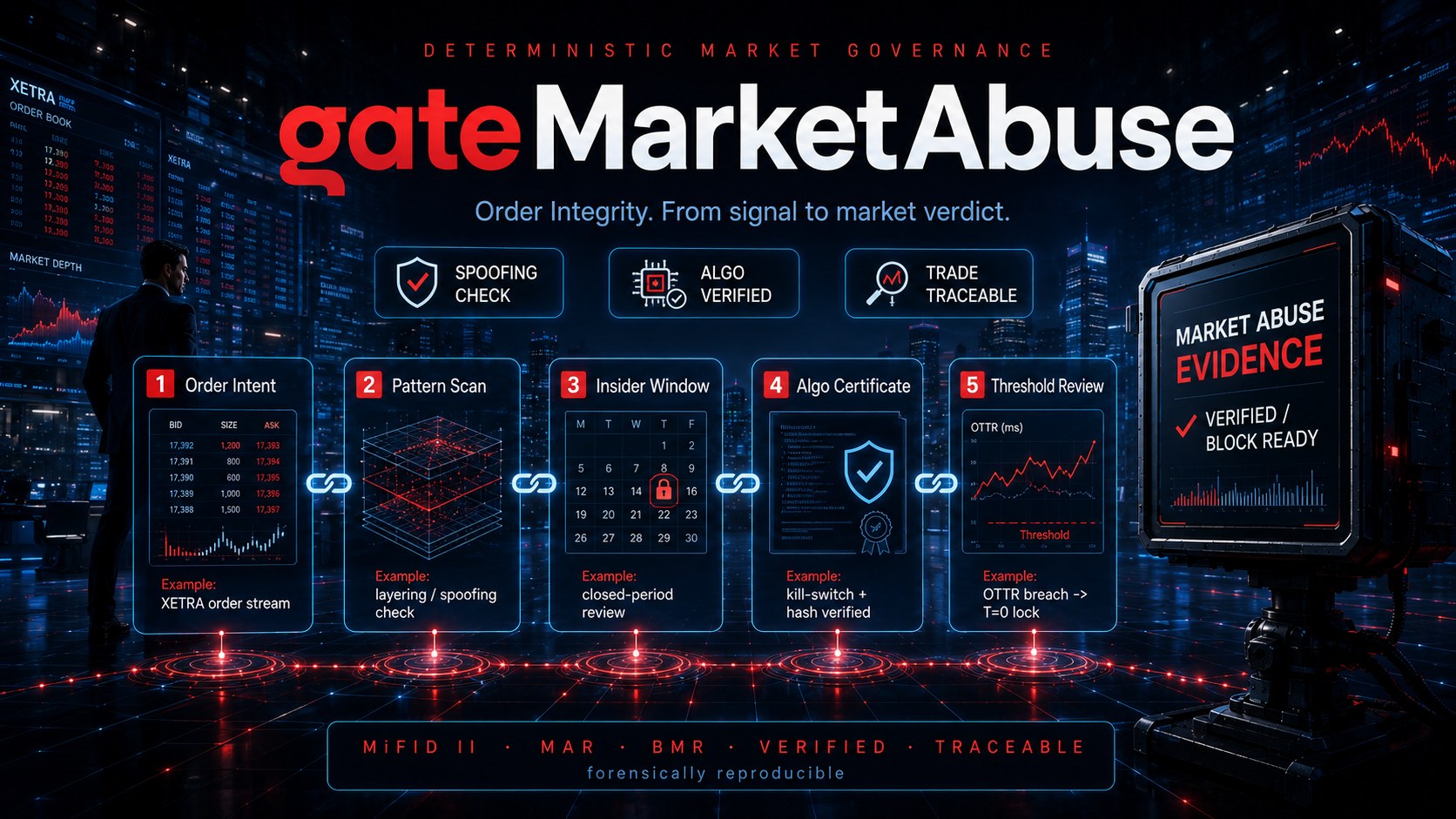
gateMarketAbuse forensically seals that an algorithmic order passes four clusters, order pattern & spoofing, insider & ad-hoc, algo certificate, and market sounding & benchmark, before it reaches the order book. Support for trading venues and regulators, never a replacement for a regulator's own recognition as evidence.

In one sentence: gateMarketAbuse checks every algorithmic order against spoofing, insider, and certification duties before it reaches the order book, and seals the result cryptographically.
✓ RELEVANT IF...
  • You operate algorithmic or high-frequency trading under MiFID II and MAR
  • You need to deterministically rule out spoofing, layering, and insider trading before order execution
✕ NOT RELEVANT IF...
  • You expect BaFin or the SEC to automatically recognise the result as evidence
  • No algorithmic trading or order execution at a venue is involved
// The problem

Manipulated high-frequency trading costs billions, in milliseconds.

When a bank manipulates the market through spoofing or layering, the board is personally liable, and SEC or BaFin penalties run into the billions. The gate sits directly ahead of order execution and deterministically validates every algorithmic decision against the Market Abuse Directive.

Board liability under §54 WpHG deterministically discharged
§54 WpHG and §30 OWiG (new) target the board personally in cases of market manipulation. A deterministic T=0 order lock prevents the manipulated order from ever reaching the order book, structurally relieving the board of the execution decision.
// Architecture

Four clusters, checked sequentially.

Every cluster is dispositive (material_block_mode: true), a hit blocks bindingly, not merely for documentation. That is the default at this systemic bottleneck.

CLUSTER 1
Order Pattern & Spoofing
Checks the order-to-trade ratio (threshold 5.0), spoofing signature, and layering signature in real time before execution.
order_to_trade_ratio · spoofing_signature · layering_signature
CLUSTER 2
Insider & Ad-Hoc
Checks insider-list membership, closed-period trading restrictions, and the three-day notification deadline for PDMR (managers' transactions).
insider_list_match · closed_period_active · pdmr_notification_days
CLUSTER 3
Algo Certificate
Checks the algorithm's certificate ID, the mandatory presence of a kill switch, stress-test approval, and the algorithm hash (64-hex).
algo_certificate_id · kill_switch_present · algo_hash
CLUSTER 4
Market Sounding & Benchmark
Checks the presence of the market-sounding protocol (safe harbour) and the integrity of the benchmark input data along with the administrator ID.
market_sounding_protocol · benchmark_input_integrity
Fatal test case: spoofing signature detected
An order-to-trade ratio of 8.5 with a detected spoofing signature triggers BLOCK_M1_SPOOFING_DETECTED. The T=0 order-execution lock engages before the manipulated order ever reaches the order book.
// Test results

Two tested scenarios.

All values on this page are fictional test data and serve only to illustrate the gate logic.

Scenario C1C2C3C4 Verdict Latency
DB_DE XETRA algo, OTTR 1.2, kill switch on, EONIA-EMVO OKPASSPASSPASSPASSMARKET_ABUSE_SEALED662ms
Commerzbank OTTR 8.5, spoofing signatureFAILnot evaluatednot evaluatednot evaluatedBLOCK_M1_SPOOFING_DETECTED618ms
Cryptographic chain continuation
Every test produces a deterministic receipt_id (VAR-MABU-{TENANT}-{SEQ}), an input_snapshot_hash, an HMAC-SHA256 signature, and a merkle_link to the previous receipt. Persistence occurs in the MarketAbuseReceipt entity with a 10-year retention period.
// Clarification

What gateMarketAbuse is not.

  • Not automatic recognition by BaFin, ESMA, or the SEC. The gate delivers a cryptographic proof, not regulatory admission as evidence.
  • Not an independent trade surveillance system. The gate seals order attestation, it does not replace the venue's ongoing market surveillance.

For trading venues and regulators that want to make algorithmic orders forensically re-computable.

Request Access →