Language:
PRODUCTS
MORE
Quantum Security 🔍 Search Request Access →
gateOECDUngp — International Due Diligence Baseline Gate
// IMMO.QUICK · GATEOECDUNGP · OECD ANTI-BRIBERY 1997 · UN GUIDING PRINCIPLES

The international floor, beneath every due diligence law.

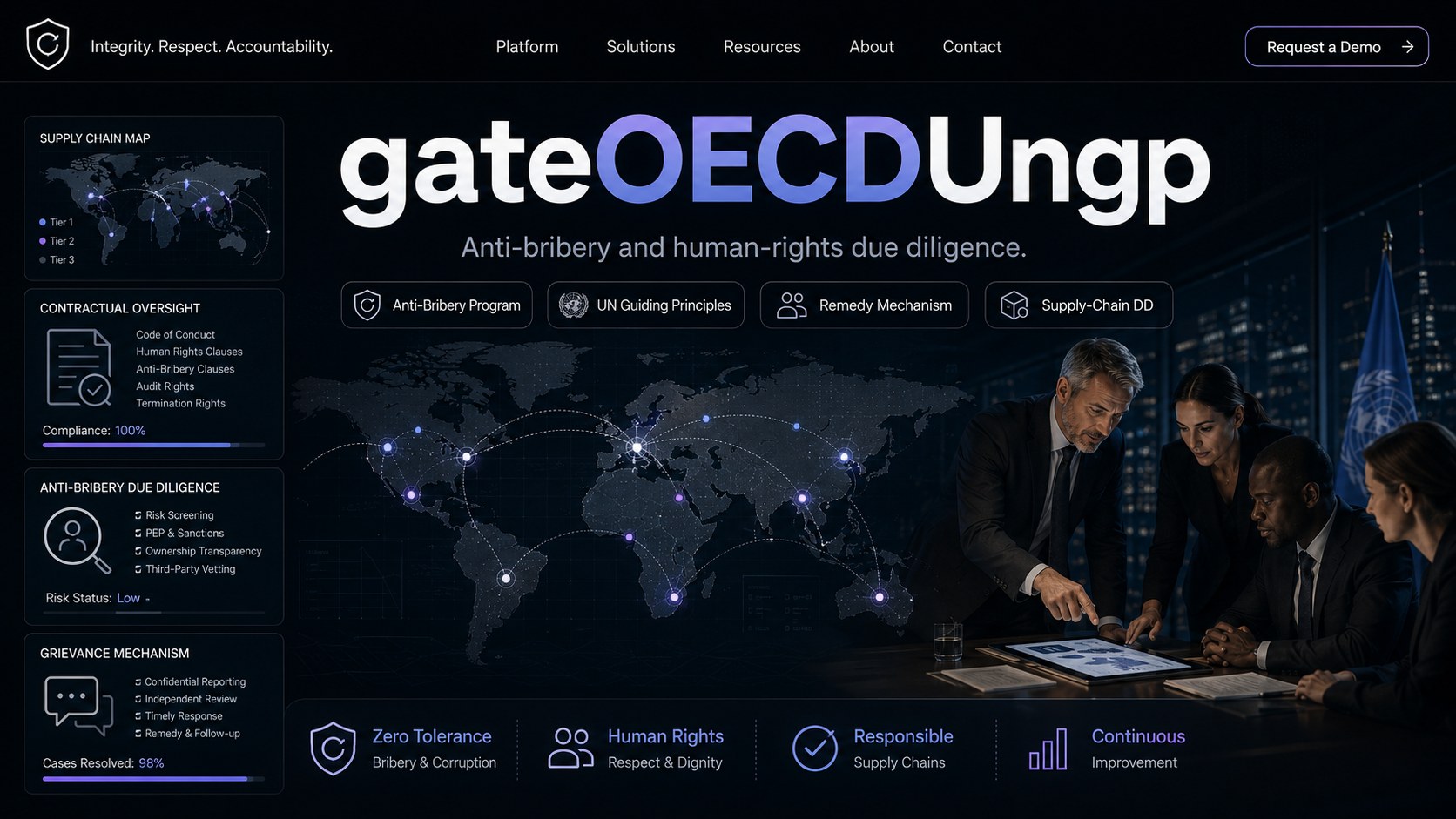
gateOECDUngp forensically seals that a supplier onboarding passes four clusters, anti-bribery programme, human-rights due diligence, grievance mechanism, and supply-chain review, as the international foundation beneath the CSDDD, the LkSG, and comparable national laws. Support for international groups, never a replacement for recognition under any specific national law.

In one sentence: gateOECDUngp checks every supplier onboarding against the international due diligence baseline, regardless of which national law additionally applies.
✓ RELEVANT IF...
  • You onboard international suppliers in jurisdictions without their own due diligence law
  • You are subject to FCPA-like duties without a direct US nexus
✕ NOT RELEVANT IF...
  • You expect the OECD itself to recognise the result as national approval
  • No supplier onboarding or international business relationship is involved
// The problem

Not every jurisdiction has a CSDDD or an LkSG.

The OECD Anti-Bribery Convention and the UN Guiding Principles are the common denominator from which the CSDDD, the LkSG, the UK Modern Slavery Act, and the Australian Modern Slavery Act 2018 are all derived. gateOECDUngp checks directly against that denominator.

Grievance mechanism as its own, often missing cluster
Many compliance programmes have an anti-bribery policy but no accessible, independent grievance mechanism under UN Guiding Principles 25 to 30. The gate checks both separately.
// Architecture

4 clusters, checked sequentially.

Every cluster is dispositive (material_block_mode: true), a hit blocks bindingly, not merely for documentation.

CLUSTER 1
Anti-Bribery Programme
Checks red-flag detection and due diligence on intermediaries under the OECD Good Practices Guidance.
abp_documented · intermediary_dd_completed
CLUSTER 2
Human Rights Due Diligence
Checks policy commitment and ongoing tracking under UN Guiding Principles 11 to 15.
hr_policy_committed · tracking_active
CLUSTER 3
Grievance Mechanism
Checks accessibility and independence of the grievance procedure under UN Guiding Principles 25 to 30.
grievance_mechanism_accessible
CLUSTER 4
Supply Chain Due Diligence
Checks contractual anti-bribery and human-rights clauses in the supplier contract.
supply_chain_clauses_present
No case, no doubt
Every cluster returns its own sealed result. A single hit in an active cluster is enough to block the overall action.
// Test results

Two tested scenarios.

All values on this page are fictional test data and serve only to illustrate the gate logic.

Scenario C1C2C3C4 Verdict Latency
New supplier in Asia, anti-bribery clause present, grievance procedure establishedPASSPASSPASSPASSOECDUNGP_SEALED329ms
Supplier contract without a human-rights clause and without a grievance procedurePASSPASSFAILnot evaluatedBLOCK_OU3_GRIEVANCE_MISSING347ms
Cryptographic chain continuation
Every test produces a deterministic receipt_id, an input_snapshot_hash, an HMAC-SHA256 signature, and a merkle_link to the previous receipt. Persistence occurs in the gateOECDUngpReceipt entity with a 10-year retention period.
// Clarification

What gateOECDUngp is not.

  • Not automatic recognition by the OECD or the UN itself. The gate delivers a cryptographic proof, not international-law certification.
  • Not a replacement for CSDDD or LkSG compliance. The gate provides the international foundation, not national fulfilment itself.

For international groups that want to make the global due diligence baseline provable.

Request Access →