Language:
PRODUCTS
MORE
Quantum Security 🔍 Search Request Access →
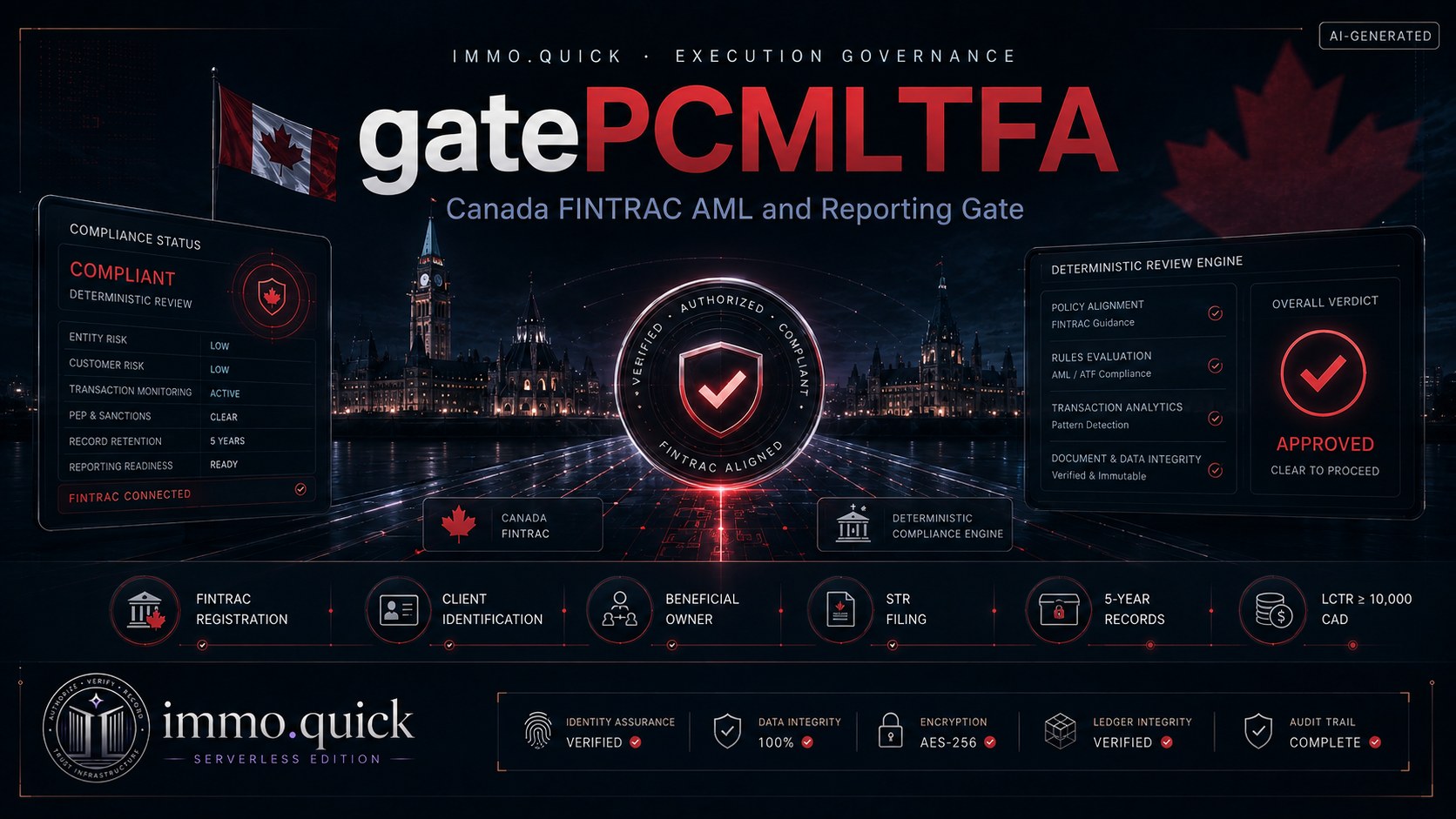
gatePCMLTFA — Canada FINTRAC AML and Reporting Gate
// IMMO.QUICK · GATEPCMLTFA · PCMLTFA PART 1 · FINTRAC

Ten boolean parameters, no external API.

gatePCMLTFA forensically seals that a Canadian financial institution passes ten FINTRAC parameters, pure deterministic computation with no network dependency, before a transaction counts as AML-compliant. Support for FINTRAC-reporting entities, never a replacement for FINTRAC's own recognition.

In one sentence: gatePCMLTFA checks ten boolean FINTRAC parameters as pure computation, no external API, with the lowest latency of any Geopolitical Governance gate.
✓ RELEVANT IF...
  • You are a Canadian financial institution or casino with a FINTRAC reporting duty
  • You need to demonstrably monitor the LCTR cash-reporting threshold of 10,000 CAD
✕ NOT RELEVANT IF...
  • You expect FINTRAC to automatically recognise the result as a complete filing
  • No Canadian reporting entity or PCMLTFA duty is involved
// The problem

A reporting threshold that exists only in someone's head becomes a problem at the next audit.

The PCMLTFA requires ten documented compliance building blocks. gatePCMLTFA checks all ten as pure boolean computation, with no external API dependency, which guarantees determinism and the lowest latency of any gate in this group.

LCTR at 10,000 CAD as its own transaction-bound cluster
The Large Cash Transaction Reporting duty at 10,000 CAD is handled separately from the general compliance-programme check, because it is triggered transaction-specifically, not held permanently.
// Architecture

5 clusters, checked sequentially.

Every cluster is dispositive (material_block_mode: true), a hit blocks bindingly, not merely for documentation.

CLUSTER 1
FINTRAC Registration & Programme
Checks FINTRAC registration (§5), documented compliance programme (§6), and a designated compliance officer.
fintrac_registered · compliance_program · officer_designated
CLUSTER 2
Client Identification & UBO
Checks completed client identification (§7) and identified beneficial owner (§9).
client_id_complete · ubo_identified
CLUSTER 3
STR & Risk Assessment
Checks STR filing where required (§7.1) and a current risk assessment (§9.1).
str_filed_if_required · risk_assessment_current
CLUSTER 4
Retention & Third-Party Determination
Checks 5-year record retention (§12) and third-party determination (§73).
retention_5y · third_party_determined
CLUSTER 5
LCTR at 10,000 CAD
Checks LCTR filing for cash transactions of 10,000 CAD or more (§14).
lctr_filed_if_applicable
No case, no doubt
Every cluster returns its own sealed result. A single hit in an active cluster is enough to block the overall action.
// Test results

Two tested scenarios.

All values on this page are fictional test data and serve only to illustrate the gate logic.

Scenario C1C2C3C4C5 Verdict Latency
Full FINTRAC compliancePASSPASSPASSPASSPASSPCMLTFA_SEALED317ms
Full non-compliance, 6 criticalFAILFAILFAILnot evaluatednot evaluatedBLOCK_PCMLTFA_NONCOMPLIANT588ms
MSB partial, 3 warningsPASSWARNWARNPASSnot applicableWARN_PCMLTFA_PARTIAL490ms
Casino, LCTR 25,000 CAD not filedPASSPASSPASSPASSFAILBLOCK_PCMLTFA_S14_NO_LCTR495ms
Cryptographic chain continuation
Every test produces a deterministic receipt_id, an input_snapshot_hash, an HMAC-SHA256 signature, and a merkle_link to the previous receipt. Persistence occurs in the gatePCMLTFAReceipt entity with a 10-year retention period.
// Clarification

What gatePCMLTFA is not.

  • Not automatic recognition by FINTRAC. The gate delivers a cryptographic proof, not regulatory filing confirmation.
  • Not an independent filing system. The gate seals the pre-check, it does not itself file an STR or LCTR with FINTRAC.

For Canadian financial institutions that want to make FINTRAC compliance provable.

Request Access →