Language:
PRODUCTS
MORE
Quantum Security 🔍 Search Request Access →
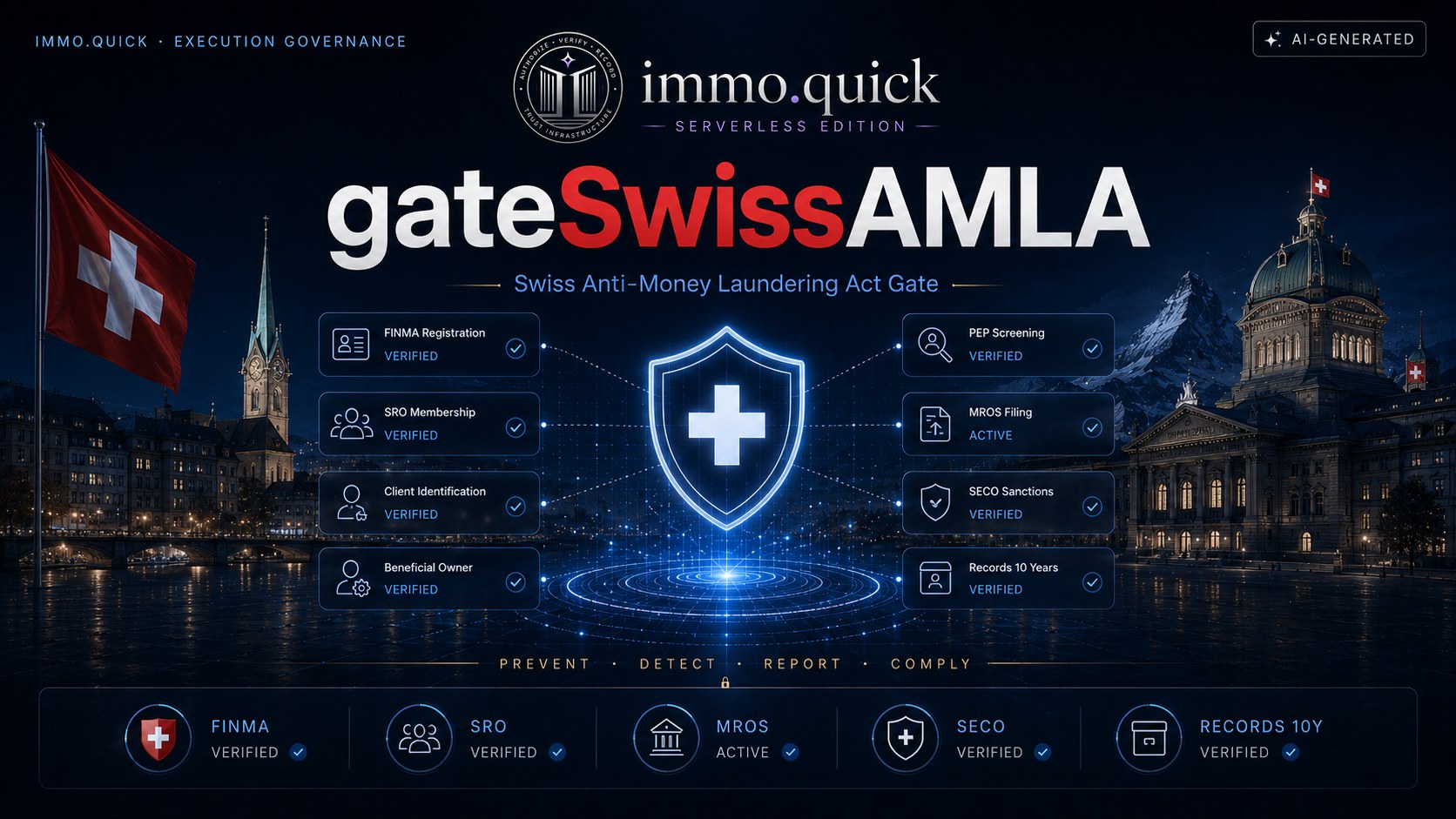
gateSwissAMLA — Swiss Anti-Money Laundering Act (GwG) Gate
// IMMO.QUICK · GATESWISSAMLA · GWG SR 955.0 · FINMA

Ten years of retention, two registration paths.

gateSwissAMLA forensically seals that a financial intermediary passes eleven parameters of the Swiss Anti-Money Laundering Act, via either the FINMA or the SRO path, with a ten-year retention period. Support for Swiss financial intermediaries, never a replacement for FINMA's own recognition.

In one sentence: gateSwissAMLA checks both possible registration paths, direct at FINMA or via a self-regulatory organisation, deterministically and on equal footing.
✓ RELEVANT IF...
  • You are a Swiss financial intermediary with a GwG due diligence duty
  • You need to demonstrably monitor the ten-year retention period and the MROS filing duty
✕ NOT RELEVANT IF...
  • You expect FINMA to automatically recognise the result as a complete registration
  • No Swiss financial intermediary or GwG duty is involved
// The problem

Two equally valid registration paths mean two places where something can be missed.

Financial intermediaries can either register directly with FINMA or join a self-regulatory organisation (SRO). gateSwissAMLA checks both paths in a hardcoded, deterministic way, regardless of which one was chosen.

Ten-year retention as a Swiss particularity
While most other jurisdictions require five to seven years, Art. 7 GwG mandates ten years, the longest period of any implemented jurisdiction. The gate checks this value independently, not as a generic default.
// Architecture

4 clusters, checked sequentially.

Every cluster is dispositive (material_block_mode: true), a hit blocks bindingly, not merely for documentation.

CLUSTER 1
Registration (FINMA or SRO)
Checks FINMA registration (Art. 2) or alternatively SRO membership (Art. 2(2)), both paths checked on equal footing.
finma_registered OR sro_member
CLUSTER 2
Client Identification & UBO
Checks client identification before a relationship of 15,000 CHF or more (Art. 3) and beneficial owner at 25% or more (Art. 4).
client_id · ubo_25pct
CLUSTER 3
PEP & Risk Classification
Checks PEP screening (Art. 3(3)) and documented risk classification (Art. 5).
pep_screened · risk_classified
CLUSTER 4
MROS & SECO & Retention
Checks MROS filing (Art. 10), SECO sanctions screening, and 10-year retention (Art. 7).
mros_filed_if_required · seco_screened · retention_10y
No case, no doubt
Every cluster returns its own sealed result. A single hit in an active cluster is enough to block the overall action.
// Test results

Two tested scenarios.

All values on this page are fictional test data and serve only to illustrate the gate logic.

Scenario C1C2C3C4 Verdict Latency
Full compliance (11/11)PASSPASSPASSPASSSWISSAMLA_SEALED410ms
4 critical violationsFAILFAILnot evaluatednot evaluatedBLOCK_SWISSAMLA_11_FLAGS497ms
Cryptographic chain continuation
Every test produces a deterministic receipt_id, an input_snapshot_hash, an HMAC-SHA256 signature, and a merkle_link to the previous receipt. Persistence occurs in the gateSwissAMLAReceipt entity with a 10-year retention period.
// Clarification

What gateSwissAMLA is not.

  • Not automatic recognition by FINMA. The gate delivers a cryptographic proof, not regulatory registration confirmation.
  • Not a replacement for the actual MROS filing. The gate seals the pre-check, it does not itself file with the reporting office.

For Swiss financial intermediaries that want to make GwG compliance provable across both registration paths.

Request Access →