Language:
PRODUCTS
MORE
Quantum Security 🔍 Search Request Access →
gateUSLaws — Twelve-plus frameworks, one calculated risk score.
// IMMO.QUICK · GATEUSLAWS · BSA · FATCA · CTA · DODD-FRANK · SOX · FCPA

Twelve-plus frameworks, one calculated risk score.

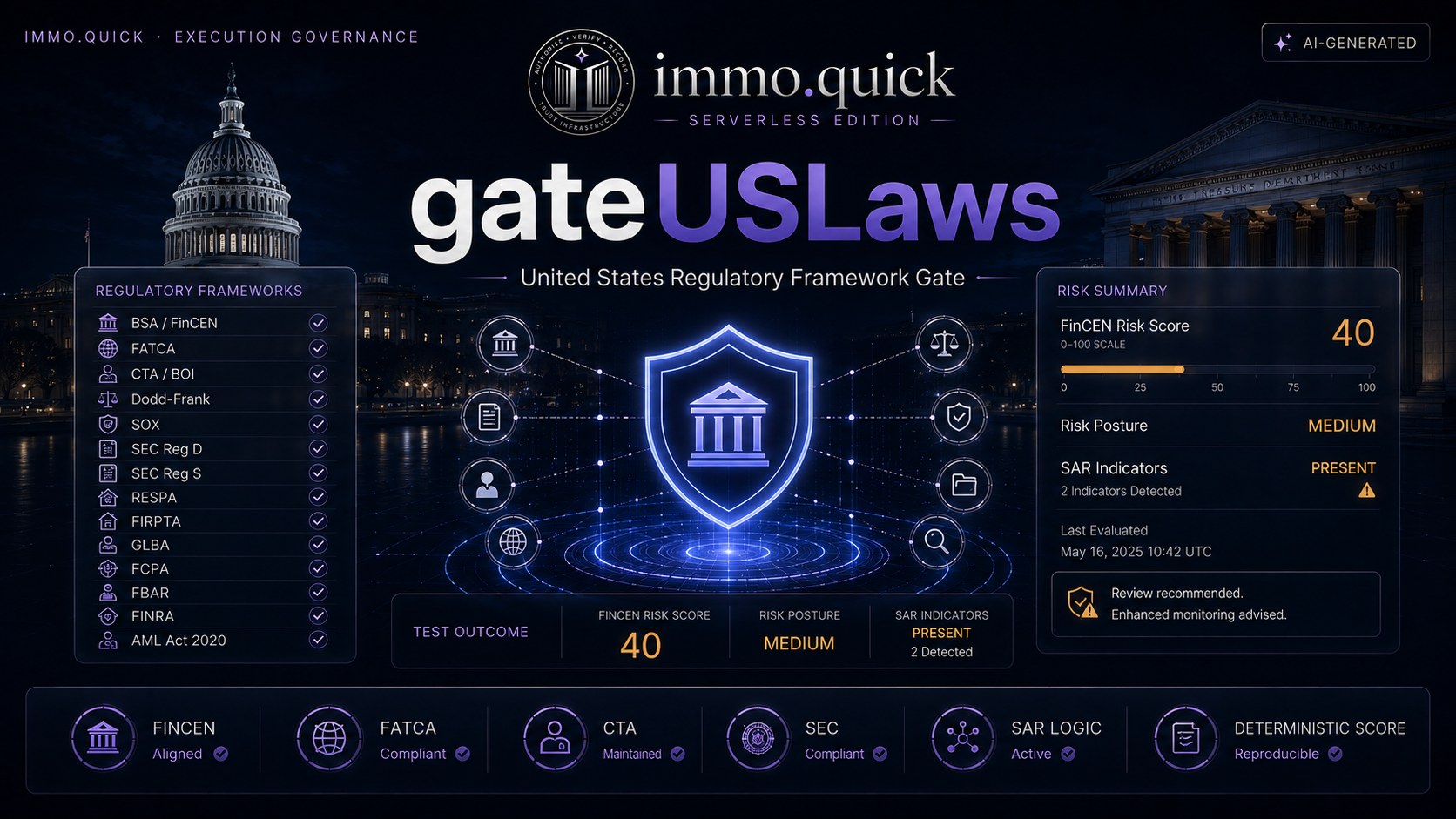
gateUSLaws checks US law across more than twelve frameworks: BSA and FinCEN, FATCA, CTA and BOI, Dodd-Frank, SOX, SEC Reg D and S, RESPA and FIRPTA, GLBA, FCPA, FBAR and FinCEN 114, FINRA, AML Act 2020. The CTA/BOI check is part of this broad overview, the deep UBO check with the 25 percent threshold stays with gateCTA, the already live dedicated gate. Both share the same rule core.

Test result: PASS. USA, FinCEN risk score 40 (MEDIUM), SAR indicators present, 369 milliseconds.
✓ RELEVANT IF...
  • You need a calculated FinCEN risk assessment across more than twelve US frameworks in one run
× NOT RELEVANT IF...
  • You only need the deep UBO check under the Corporate Transparency Act, then gateCTA is the direct right choice
// Architecture

Risk score calculation in the test run.

Every row is a hard boolean check, not probabilistic scoring. A critical failure leads to block, a high severity failure to warn, everything else to pass.

ReferenceChecksSeverity
FinCEN Risk Score40 out of 100, classified MEDIUMmedium
SAR-Indikatorbeneficial_owner_unknownhigh
SAR-Indikatorlarge_transaction, USD 100,000high
31 CFR 1020.320SAR recommended, not mandatory, threshold not reachedmedium
CTRnot mandatorymedium
HMAC-signed GateLog record
Every run writes an HMAC-signed GateLog record with identity binding (caller_did, caller_role) and a ten-year retention period. Deterministic: identical input produces identical output, no LLM, no external API.
// Clarification

What gateUSLaws is not.

  • Not a second truth alongside gateCTA. Both gates check the same rule core, gateUSLaws as a broad overview with a risk score, gateCTA as the UBO deep check.

For institutions with US business who want a calculated FinCEN risk score across twelve-plus frameworks alongside their gateCTA deep check.

Request Access →