Language:
PRODUCTS
MORE
Quantum Security 🔍 Search Request Access →
gateWHGAwSV — PFAS Water Discharge Gate
UPDATED · WATER FRAMEWORK DIRECTIVE
// IMMO.QUICK · GATEWHGAWSV · WHG § 57 · AWSV ANHANG · TRINKWV 2023 · WFD 3RD CYCLE

No discharge, above the PFAS limit.

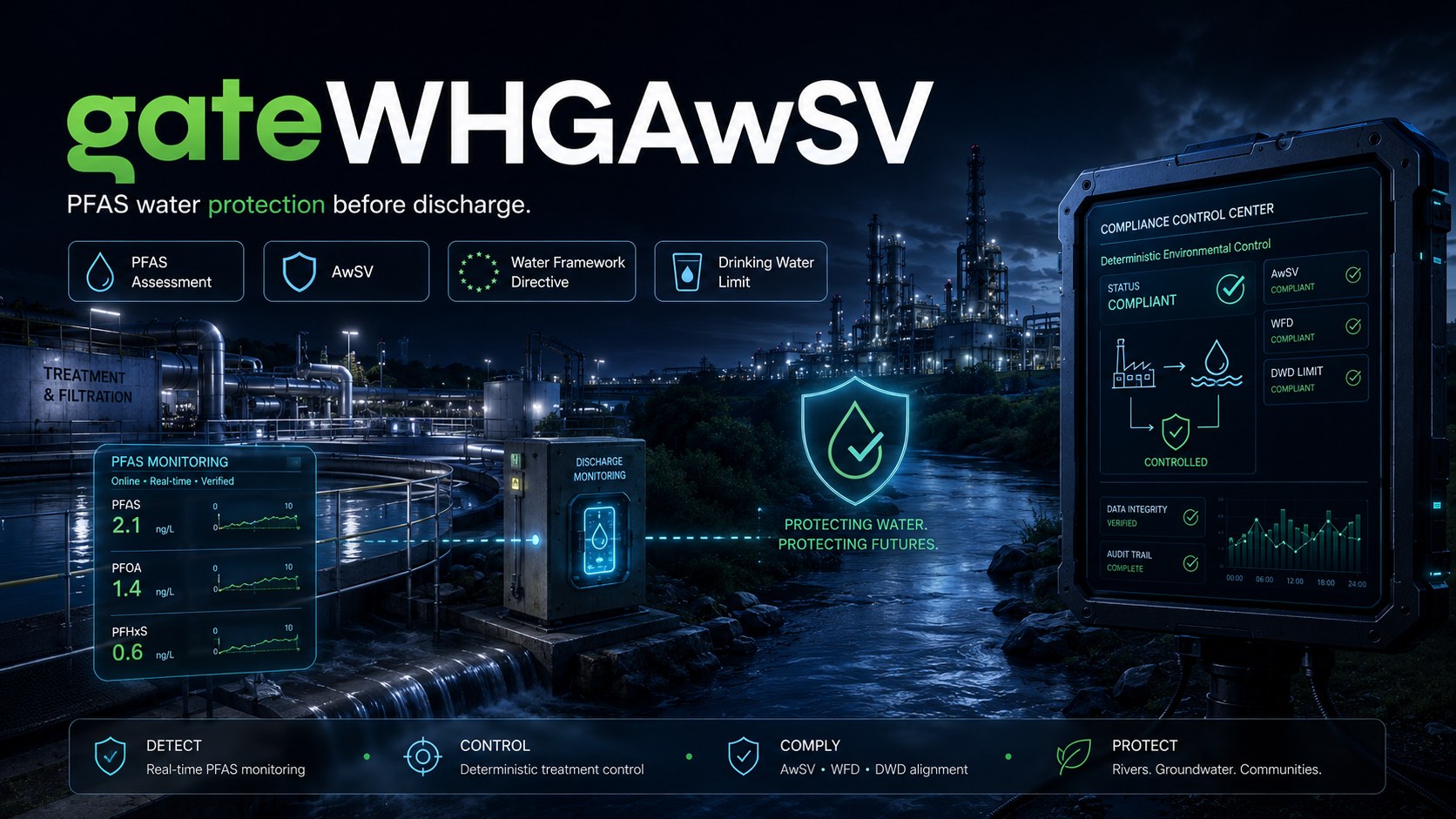
gateWHGAwSV forensically seals that an industrial wastewater discharge passes six clusters, PFAS discharge, drinking water limit, wastewater treatment, Water Framework Directive status under the third river basin management cycle 2022–2027, CJEU Pfaff compliance, and the Drinking Water Ordinance, before discharge at T=0. Support for chemical companies and water utilities, never a replacement for the water-law permit itself.

In one sentence: gateWHGAwSV checks every industrial wastewater discharge against PFAS limits for drinking water and surface water, before the discharge physically occurs.
✓ RELEVANT IF...
  • You discharge PFAS-containing wastewater from an industrial production process
  • You need to prove drinking-water limits under the new TrinkwV and the CJEU Pfaff ruling
✕ NOT RELEVANT IF...
  • You expect a water authority to automatically recognise the result as a discharge permit
  • No PFAS-relevant wastewater discharge or drinking water supply is involved
// The problem

PFAS do not degrade, a limit violation today stays in the water cycle for decades.

With the Pfaff ruling, the CJEU tightened PFAS drinking-water limits through 2030. gateWHGAwSV checks the full substance list under the AwSV annex and the 2023 Drinking Water Ordinance before every discharge.

Water Framework Directive status as its own cluster
Good ecological and chemical status under the Water Framework Directive must be achieved by 2027. The gate checks the current status of the affected catchment area before every new discharge.
// Architecture

6 clusters, checked sequentially.

Every cluster is dispositive (material_block_mode: true), a hit blocks bindingly, not merely for documentation.

CLUSTER 1
PFAS Discharge
Checks the discharge against the full PFAS substance list under WHG §57 and the AwSV annex.
pfas_assessment_hash
CLUSTER 2
Drinking Water Limit
Checks the PFAS sum parameter against the 0.1 µg/l limit under WHG §37.
drinking_water_pfas_ugl
CLUSTER 3
Wastewater Treatment
Checks treatment plant processing before discharge into protection zones under WHG §56/§57.
treatment_documented
CLUSTER 4
WFD Status
Checks the good ecological and chemical status of the catchment area under Water Framework Directive 2000/60/EC.
wfd_status_good
CLUSTER 5
CJEU Pfaff Compliance
Checks that the CJEU Pfaff ruling on PFAS in drinking water through 2030 is accounted for.
pfaff_compliance_hash
CLUSTER 6
Drinking Water Ordinance 2023
Checks the PFAS sum parameter under the 2023 Drinking Water Ordinance and EU Directive 2020/2184.
trinkwv_compliant
No case, no doubt
Every cluster returns its own sealed result. A single hit in an active cluster is enough to block the overall action.
// Test results

Two tested scenarios.

All values on this page are fictional test data and serve only to illustrate the gate logic.

Scenario C1C2C3C4C5C6 Verdict Latency
Chemical production, PFAS sum parameter 0.04 µg/l, treatment plant documented, catchment good statusPASSPASSPASSPASSPASSPASSWHGAWSV_SEALED421ms
Discharge with drinking-water sum parameter 0.18 µg/l above the limitPASSFAILnot evaluatednot evaluatednot evaluatednot evaluatedBLOCK_WH2_TRINKWV_LIMIT_EXCEEDED375ms
Cryptographic chain continuation
Every test produces a deterministic receipt_id, an input_snapshot_hash, an HMAC-SHA256 signature, and a merkle_link to the previous receipt. Persistence occurs in the gateWHGAwSVReceipt entity with a 10-year retention period.
// Clarification

What gateWHGAwSV is not.

  • Not automatic recognition by the competent water authority. The gate delivers a cryptographic proof, not a water-law permit.
  • Not an independent measurement system. The gate checks reported readings, it does not perform its own laboratory analysis.

For chemical companies and water utilities that want to make PFAS discharge provable.

Request Access →