Language:
PRODUCTS
MORE
Quantum Security 🔍 Search Request Access →
gateEmergencyPowersReview — Emergency Powers Judicial Review Gate
// IMMO.QUICK · GATEEMERGENCYPOWERSREVIEW · GG ART. 13 ABS. 3 · ART. 20 ABS. 3 · PKGRG · § 100B STPO

No lock without a deadline, no deadline without an unlock.

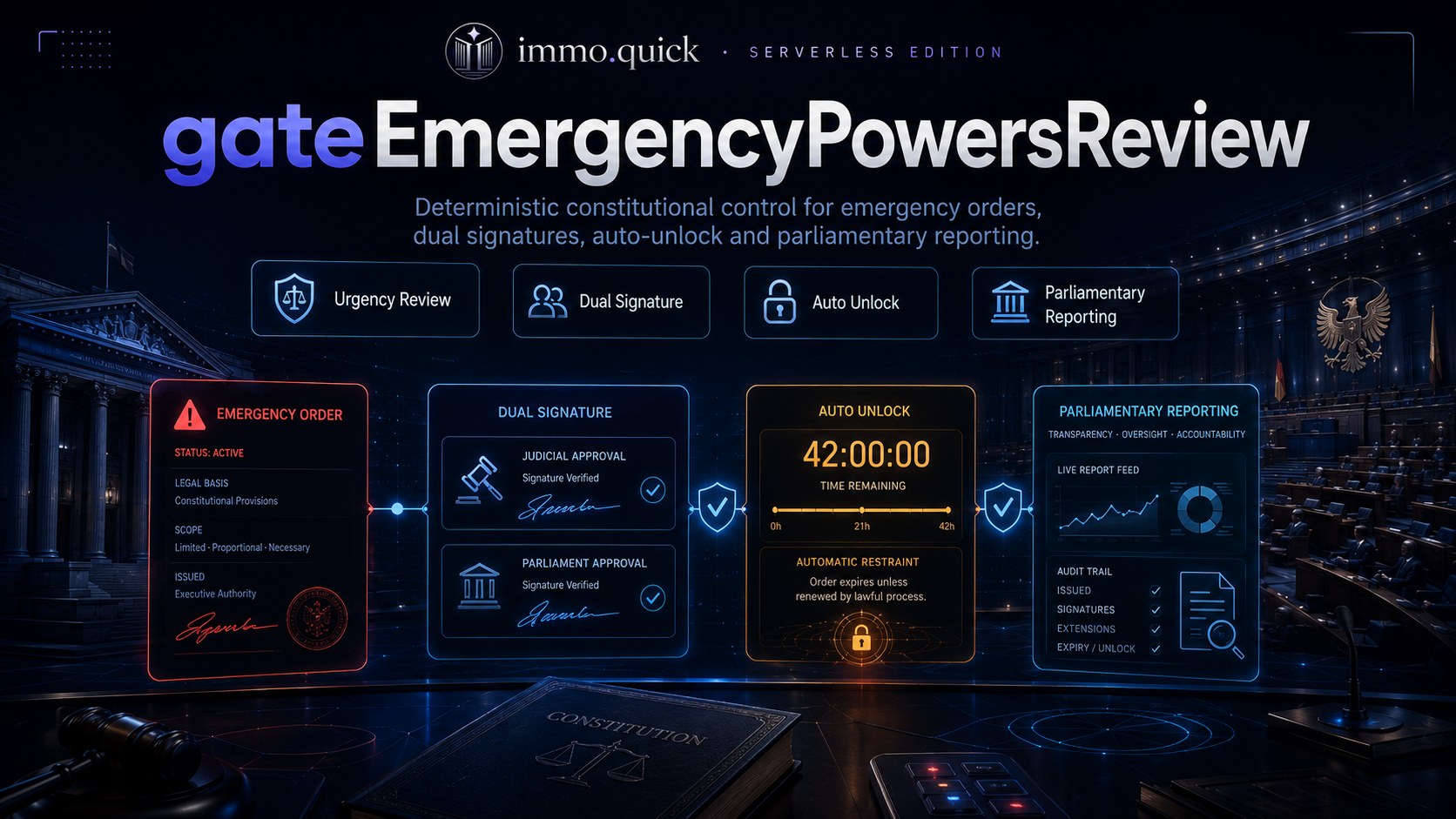
gateEmergencyPowersReview forensically seals that an emergency order passes four clusters, urgency classification, dual-signature principle, automatic deadline monitoring, and parliamentary reporting, and sits ahead of every authority with emergency powers. Support for authorities and oversight bodies, never a replacement for constitutional control itself.

In one sentence: gateEmergencyPowersReview architecturally enforces that a single agency signature can never permanently lock down a sector on its own.
✓ RELEVANT IF...
  • You need to sit ahead of an authority with executive emergency or urgent powers
  • You need an emergency measure to automatically unlock if the second signature does not arrive
✕ NOT RELEVANT IF...
  • You expect this gate itself to replace a judicial or parliamentary decision
  • No executive emergency power or sector lockdown is involved
// The problem

An authority that locks down a sector by signature is an executive fundamental-rights intrusion.

An authority able to lock down an entire sector by signature alone, without a judge, without parliament, would otherwise be subject to a judicial-warrant requirement under German law, comparable to a home search. gateEmergencyPowersReview enforces this control architecturally, not merely as a promise.

From the maximum political lever to a constitutionally reviewed instrument
Without this gate, the quarantine function was politically the maximum lever and legally the biggest weak point. With this gate, it is neither, it is not maximally unbound nor is it vulnerable to challenge, because the unlock is automatic and the reporting duty is deterministic.
// Architecture

Four clusters, checked sequentially.

Every cluster is dispositive (material_block_mode: true), a hit blocks bindingly, not merely for documentation. That is the default at this systemic bottleneck.

CLUSTER 1
Urgency Classification
Requires a written justification of minimum length explaining why imminent danger exists and the regular two-signature path cannot be followed. Without justification, the gate requires the regular path.
urgency_justification_text · justification_min_length
CLUSTER 2
Dual Signature Principle
Requires two cryptographic signatures in regular mode, the authority and an independent second instance (emergency judge analogous to §100b StPO, or the Parliamentary Control Panel). In emergency mode, action is taken immediately, but status remains pending.
authority_signature · second_signature_present · mode
CLUSTER 3
Automatic Deadline Monitoring & Unlock
In emergency mode, records an automatic unlock time (submission plus 42 hours). If the deadline passes without a second signature, the status switches to deadline expired, auto-unlock, without any manual intervention.
submission_timestamp · auto_unlock_deadline · second_signature_received
CLUSTER 4
Forensic Documentation & Parliamentary Reporting
Seals every emergency measure with its justification and automatically forwards it to the Parliamentary Control Panel within 24 hours. If the record or forwarding is missing, the gate blocks.
forensic_record_sealed · pkgr_notification_hours
Fatal test case: second signature not received after 42 hours
A BSI emergency quarantine awaits judicial confirmation. After 42 hours without a second signature, the system automatically switches to AUTO_UNLOCK_EP3_JUDICIAL_CONFIRMATION_TIMEOUT, without anyone needing to intervene manually.
// Test results

Two tested scenarios.

All values on this page are fictional test data and serve only to illustrate the gate logic.

Scenario C1C2C3C4 Verdict Latency
BSI quarantine + emergency judicial signature submitted within 2 hoursPASSPASSPASSPASSEMERGENCY_POWERS_SEALED349ms
BSI quarantine without judicial confirmation after 42 hoursPASSPASSFAILnot evaluatedAUTO_UNLOCK_EP3_JUDICIAL_CONFIRMATION_TIMEOUT365ms
Cryptographic chain continuation
Every test produces a deterministic receipt_id (VAR-EMRG-{TENANT}-{SEQ}), an input_snapshot_hash, an HMAC-SHA256 signature, and a merkle_link to the previous receipt. Timestamps are supplied exclusively by the caller, never derived from the system clock. Sanctions screening runs live via the OpenSanctions API. Any exception to a block requires six-eyes approval. External trust anchors (TSA timestamp, Shamir quorum signature) are attached asynchronously and carry PENDING status until then.
// Clarification

What gateEmergencyPowersReview is not.

  • Not automatic recognition by a court or the Parliamentary Control Panel. The gate delivers a cryptographic proof, not a judicial decision.
  • Not a substitute for the judicial-warrant requirement itself. The gate architecturally enforces the second signature, it does not make the decision in place of the judge or panel.

For authorities and oversight bodies that want to secure executive emergency powers in a constitutionally sound way.

Request Access →