Language:
PRODUCTS
MORE
Quantum Security 🔍 Search Request Access →
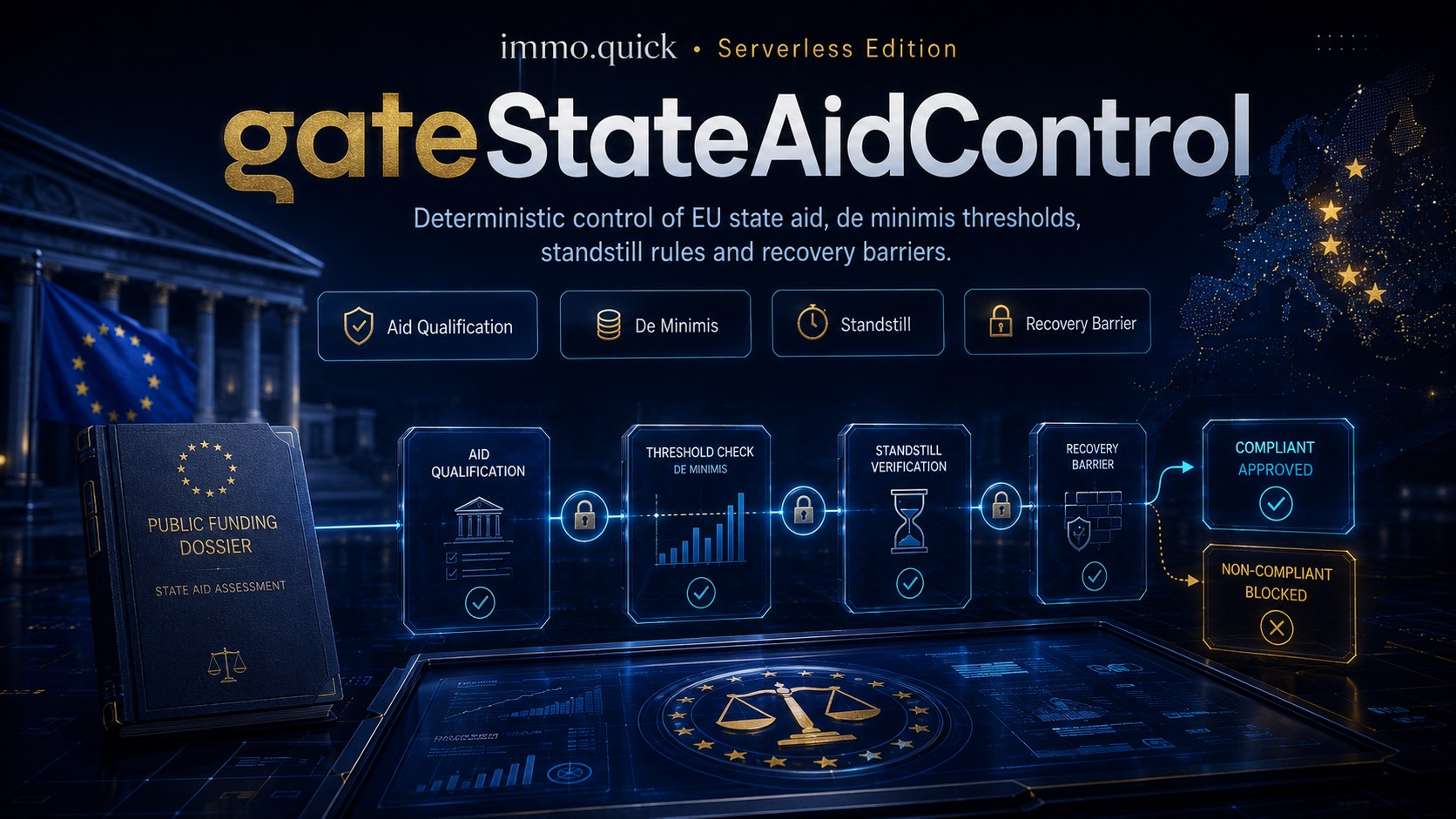
gateStateAidControl — EU State Aid Control Gate
// IMMO.QUICK · GATESTATEAIDCONTROL · ART. 107/108 AEUV · GBER · VO (EU) 2023/2831

No money moves, before Brussels has decided.

gateStateAidControl forensically seals that a public funding measure passes four clusters, aid qualification, de-minimis check, notification & standstill, and the Deggendorf recovery bar, before disbursement. Support for authorities and funding bodies, never a replacement for a regulator's own recognition as evidence.

In one sentence: gateStateAidControl reverses the order, no disbursement before all four state-aid checks are passed.
✓ RELEVANT IF...
  • You disburse state funding or grants within the EU
  • You need to check notification duties and Deggendorf recovery bars before disbursement
✕ NOT RELEVANT IF...
  • You expect the EU Commission to automatically recognise the result as approval
  • No state aid or EU state-aid matter is involved
// The problem

State-aid violations are the most expensive mistakes an authority can make.

Non-notified state aid is unlawful and must be repaid with interest, often years later. gateStateAidControl reverses the order: no money moves before all four checks are passed.

Recovery plus interest arrives years later, the gate arrives first
Previously, review was aftercare. Now the gate is the upstream gatekeeper: no money moves before the aid qualification, de-minimis limit, notification, and Deggendorf bar have been checked.
// Architecture

Four clusters, checked sequentially.

Every cluster is dispositive (material_block_mode: true), a hit blocks bindingly, not merely for documentation. That is the default at this systemic bottleneck.

CLUSTER 1
Aid Qualification
Checks the four criteria under Art. 107 TFEU cumulatively: state resources, selective advantage, distortion of competition, effect on trade. If not all four are present, the gate seals as clearance, not aid.
state_resources · selective_advantage · competition_distortion · trade_effect
CLUSTER 2
De Minimis Check
Sums the de-minimis aid already granted to the same recipient from the transparency register plus the new aid against the €300,000 limit over three tax years under Regulation (EU) 2023/2831.
cumulative_de_minimis_eur · new_aid_eur · three_year_window
CLUSTER 3
Notification & Standstill
Checks whether a required notification to the EU Commission has occurred and approval has been granted before disbursement. A payout before approval blocks as a standstill violation.
notification_filed · commission_approval_granted
CLUSTER 4
Deggendorf Recovery Bar
Checks whether the recipient has an outstanding recovery claim from aid previously declared unlawful, and blocks the new aid as long as the recovery remains outstanding.
outstanding_recovery_claim
Fatal test case: rescue aid without notification
A €5m rescue aid is disbursed without prior notification to the EU Commission. BLOCK_S3_NOTIFICATION_MISSING fires before the money moves, the standstill obligation remains intact.
// Test results

Two tested scenarios.

All values on this page are fictional test data and serve only to illustrate the gate logic.

Scenario C1C2C3C4 Verdict Latency
Investment grant €180,000, cumulative de-minimis €220,000 below the €300,000 limitPASSPASSnot evaluatedPASSSTATE_AID_SEALED358ms
Rescue aid €5m, no EU notificationPASSnot evaluatedFAILnot evaluatedBLOCK_S3_NOTIFICATION_MISSING402ms
Cryptographic chain continuation
Every test produces a deterministic receipt_id (VAR-AIDC-{TENANT}-{SEQ}), an input_snapshot_hash, an HMAC-SHA256 signature, and a merkle_link to the previous receipt. Timestamps are supplied exclusively by the caller, never derived from the system clock. Sanctions screening runs live via the OpenSanctions API. Any exception to a block requires six-eyes approval. External trust anchors (TSA timestamp, Shamir quorum signature) are attached asynchronously and carry PENDING status until then.
// Clarification

What gateStateAidControl is not.

  • Not automatic recognition by the EU Commission. The gate delivers a cryptographic proof, not state-aid approval.
  • Not an independent transparency register. The gate checks against integrated registers, it does not operate its own aid register.

For authorities and funding bodies that want to make aid disbursements provable.

Request Access →