Language:
Home Core Serverless Edition CDS — Constitutional Screening
gateSport — VAR Engine gateMotorsport — Stewarding Engine gateAntiDoping gateTransfer
gateSocialMediaLaws gateMusicCompliance gateClinicalTrials gateRealEstateTransactions gateAgriFoodCompliance gateHeavyIndustry gateEnergyGridCompliance
gateBankingCompliance gateCBDC gateHFT gateConsortiumLoans gateTaxExecution
gateLogistics gateIntralogistics gateRailLogistics gateAviationLaws
gateEsgSocial gateSustainabilityCompliance
gateGovernmentActs gateProcurement gateBundID
Pipeline Gate 0 STFL Enforced Edge Grid CRPG Cybersecurity Data Sources System Documentation
Pricing Due Diligence Machine Law — The Book Institutions Jurisdictions Press FAQ
Quantum Security Defence 🏰 🔍 Search Request Access →
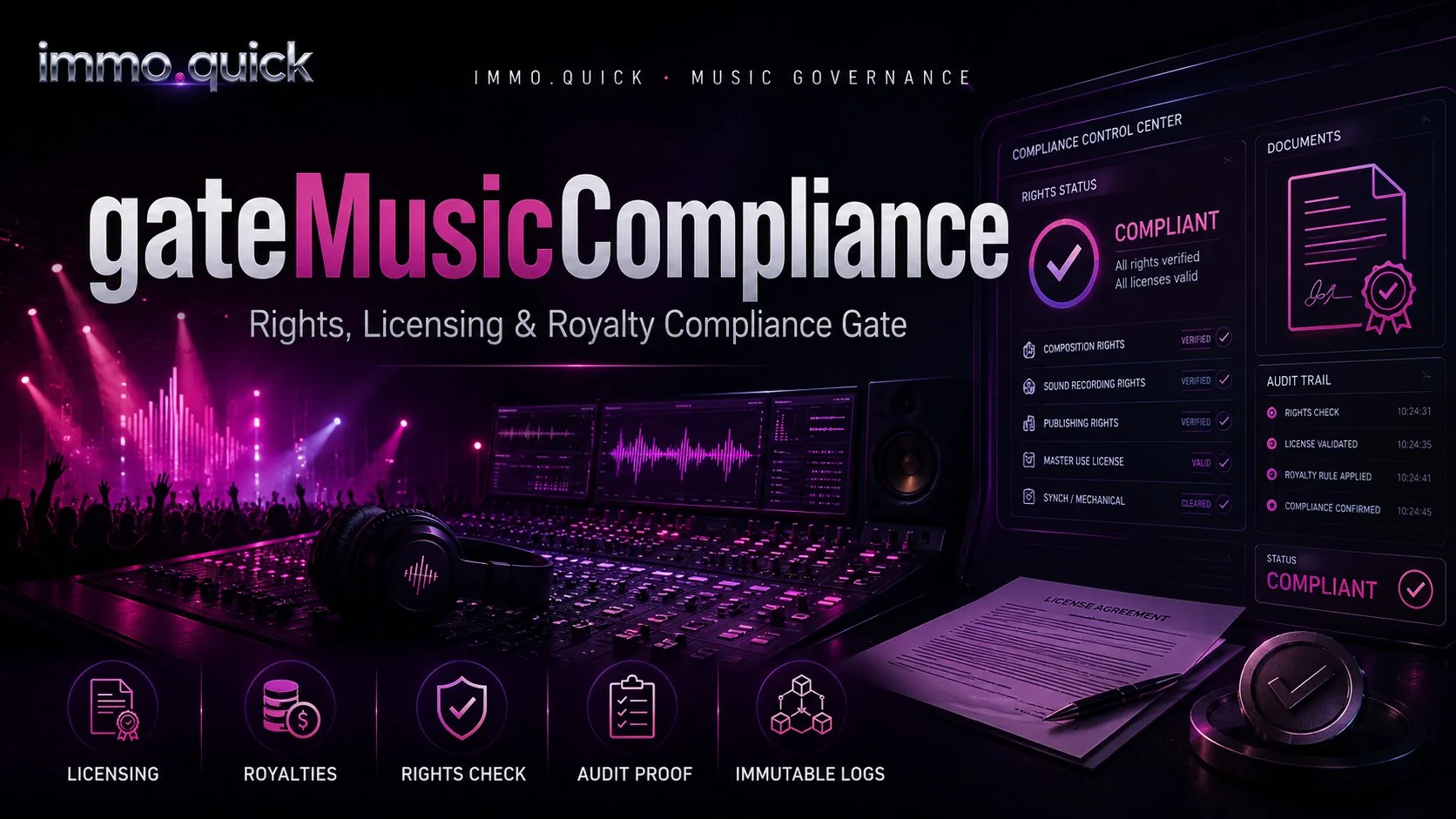
gateMusicCompliance — Rights, Licensing & Royalty Compliance Gate
// IMMO.QUICK · GATEMUSICCOMPLIANCE · SPLIT SHEETS · AI ACT · CLEARANCE

A release isn't finished until it's provable.

gateMusicCompliance seals music releases before publication, ownership splits, AI transparency under Art. 50 of the AI Act, and third-party audio clearance, with a sealed proof per submission. Support for labels and distributors, never a replacement for them.

In one sentence: gateMusicCompliance checks a release submission deterministically against three sequential gates, ownership split, AI labelling, rights clearance, and cryptographically seals the result before the release goes live.
✓ RELEVANT IF...
  • You are labels, distributors, or publishers that need to make an ownership split provable before release
  • You use AI-generated or AI-assisted material and need to document the labelling obligation
  • You use sample or sync material and need to forensically prove rights clearance
× NOT RELEVANT IF...
  • You expect a system to obtain or negotiate rights clearance itself
  • No release, ownership split, or third-party material is involved
// The problem

Three dispute points that only surface after release.

Who owns how much, was AI material correctly labelled, was every sample actually cleared? These questions are often only asked once a release is already live and a dispute arises. gateMusicCompliance moves the check before publication and seals the result.

// Architecture

Three gates, chained sequentially.

Gate 2 only runs if Gate 1 passes. Gate 3 only runs if Gate 2 passes. A failure breaks the chain, but fully documents every gate already checked.

GATE 1
Split Sheet Multi-Sig
Ownership sum exactly 100%, each party signs via ECDSA-P256 against the submission's intent hash
GATE 2
AI Transparency, Art. 50 AI Act
Detects the contradiction between demonstrable AI material and a missing declaration
GATE 3
Sample/Sync Clearance
Every audio hash used must be covered by at least one valid, non-expired clearance

Construction limit, openly disclosed: a valid ECDSA signature proves cryptographic correctness against the public key, not that the key actually belongs to the named person. This identity-binding gap is explicitly noted in the gate output.

Merkle-Kette: jedes versiegelte Release-Receipt wird zum Vorgänger-Hash des nächsten

Per-tenant Merkle chain, every release extends it by one link

// Examples

Three fully fictional example decisions.

All labels, artists, and values on this page are invented and serve only to illustrate the gate logic.

Complete ownership split, release sealed
gateMusicCompliance · Gate 1–3
A fictional label submits a release with four parties, songwriter, producer, lyricist, label, sum exactly 100 percent, all signatures valid, no AI material, one sample fully cleared.
split_sum_percent100.000
ai_generated_declaredfalse
clearance_coveragecomplete
RELEASE_SEALED
Proof before publication. All three gates pass before the release goes live, not reconstructed afterward.
AI material demonstrable, declaration missing
gateMusicCompliance · Gate 2
The ownership split is complete, but external evidence shows AI-generated material that was not declared in the release.
external_evidence_ai_generatedtrue
ai_generated_declaredfalse
legal_basisAI Act Art. 50
RELEASE_FLAGGED_AI_TRANSPARENCY_MISSING
Flagged, not blocked. The gate detects the contradiction between demonstrable material and missing labelling and makes it visible.
Uncleared sample in the release
gateMusicCompliance · Gate 3
An audio hash used in the release does not appear in any of the submitted clearance records.
utilized_audio_hash_coveredfalse
legal_basis17 U.S.C. · DSM 2019/790 Art. 3
RELEASE_REJECTED_CLEARANCE_MISSING
Fail-closed. A release with uncleared third-party material is not sealed, regardless of how small the portion is.
// Clarification

What gateMusicCompliance is not.

  • Not rights clearance itself. The gate checks submitted clearances, it does not obtain rights or negotiate licences.
  • Not an identity check of signatories. A valid signature proves cryptographic correctness, not the identity behind the key.
  • No certification by GEMA, ASCAP, BMI, PPL, or any other collecting society. These are private-law organisations, not legal sources.
  • No fixed application date for AI Act Art. 50 is asserted unprompted. The staggered timeline is carried as an open review point.

For labels and distributors that want to make their releases provable.

gateMusicCompliance is open for conversation with labels, distributors, publishers, and collecting societies who want to understand how deterministic governance infrastructure translates to the music industry.

Request Access →