Enforcement at the edge is impossible. Visibility is not.
The Enforced Edge Grid is not a claim that a system can centrally enforce what is allowed at every network edge. It is the honest answer to what is actually achievable under real latency constraints, forensic visibility instead of central control.
Why a central authorisation callback does not work at the edge.
A decision that must be made at a network edge within a few milliseconds cannot wait for a central server's answer without losing exactly the speed edge processing exists for. A system that nonetheless claims to centrally enforce what is allowed at every point promises something the physics of latency does not permit.
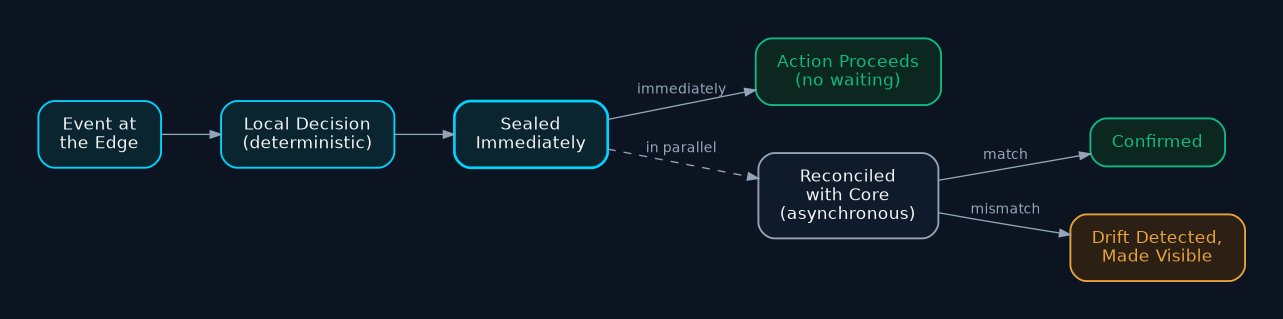
Concept illustration, not implementation detail
What the grid actually delivers.
No central gatekeeper. A forensic net that prevents nothing, but makes everything visible.
What stands today, and what remains specification.
The same discipline as every other building block: no gap is concealed.
What the Enforced Edge Grid is not.
- Not a central gatekeeper. The grid does not prevent an action at the edge at the moment it happens.
- No guarantee of under 50 milliseconds for every real network topology. The mechanics are tested, the production network property remains a separate building block.
- Not a replacement for the underlying legal review. The grid secures decision integrity, not the substantive correctness of a decision.
Questions about the architecture?
This page deliberately stays a concept, not a sales article. Deeper technical conversations happen directly.
access@immoquick.eu