Zwei Algorithmen, zwei völlig unterschiedliche Bedrohungen.
Quantum Computing ist keine einzelne Bedrohung, es sind zwei separate Algorithmen mit fundamental unterschiedlicher Wirkung, gegen fundamental unterschiedliche Kryptografie. Diese Seite geht tiefer als die allgemeine Cybersicherheits-Übersicht und zeigt genau, welcher Algorithmus welchen Teil unserer Architektur betrifft, und welcher nicht.
Was einen Quantencomputer strukturell anders macht.
Ein klassisches Bit ist entweder 0 oder 1. Ein Qubit kann beide Zustände gleichzeitig annehmen, eine Überlagerung, und mehrere Qubits können miteinander verschränkt werden, sodass der Zustand des einen vom anderen abhängt. Das erlaubt bestimmten Algorithmen, einen riesigen Lösungsraum parallel statt sequentiell zu durchsuchen.
Shor bricht Strukturen. Grover beschleunigt Suche.
Diese Unterscheidung ist der Kern der gesamten Verteidigungslogik, deshalb erst im Detail, bevor die eigene Architektur erklärt wird.
Warum ein Receipt gültig bleibt, selbst wenn ein Angreifer einen Quantencomputer besitzt.
Ein Quantencomputer greift die klassische Signatur und die symmetrische Kettenintegrität auf zwei völlig unterschiedliche Arten an. Die Post-Quantum-Signatur ist von beiden Angriffen unberührt. Ein Receipt fällt erst, wenn alle relevanten Ebenen gleichzeitig fallen, nicht wenn eine einzelne davon geschwächt wird.
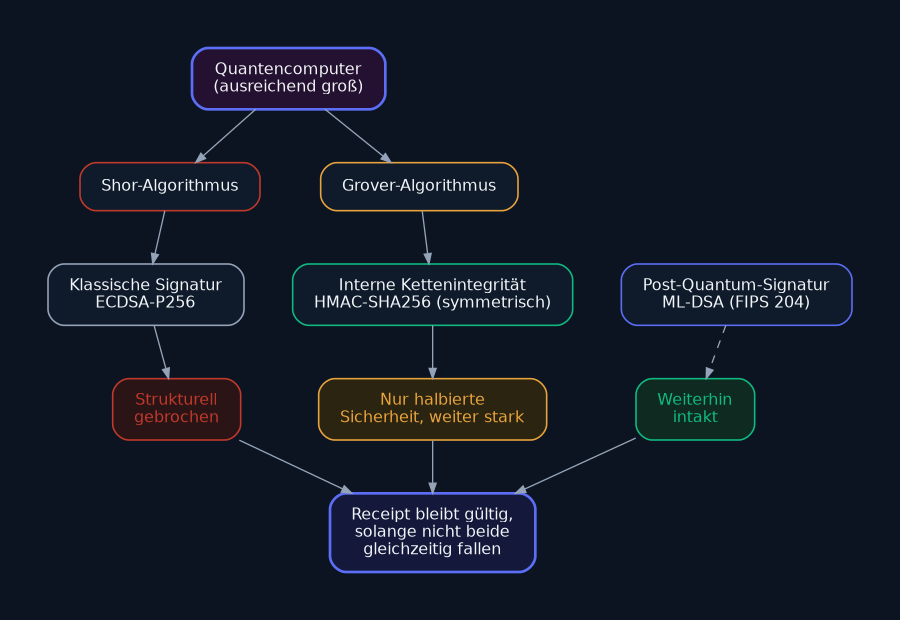
Konzeptdarstellung, kein Bruchbeweis
Sind wir quantensicher? Ja, mit einem Vorbehalt.
ML-DSA-65 (FIPS 204) läuft bei NIST-Sicherheitsstufe 3, vergleichbar mit AES-192, neben der klassischen ECDSA-P256-Signatur (NIST 186-5, Sicherheitsstufe 1). Ein Receipt bleibt authentisch, solange mindestens eine der beiden Signaturen hält. Die Schlüsselerzeugung selbst folgt einer protokollierten Zeremonie, die privaten Schlüssel werden per Shamir-Schlüsselteilung auf fünf Halter verteilt, mindestens drei müssen für jede Signatur zusammenwirken.
Der Vorbehalt: ML-DSA ist ein vergleichsweise junger Standard, die Standardisierung gilt als abgeschlossen, aber jüngere Verfahren haben naturgemäß eine kürzere Angriffshistorie als RSA oder ECC. Genau deshalb ist die hybride Kombination die vorsichtigere Wahl, nicht eine überflüssige, die Wahrscheinlichkeit, dass beide Verfahren gleichzeitig fallen, ist vernachlässigbar.
Was real ist, was Spekulation, was regulatorisch gesetzt.
Was diese Seite nicht behauptet.
- Keine Behauptung, ein Bruch der gitterbasierten Verfahren sei ausgeschlossen. ML-KEM und ML-DSA sind seit August 2024 final, jünger als RSA und ECC, die hybride Kombination ist deshalb die vorsichtigere Wahl, nicht eine überflüssige.
- Keine Aussage, dass ein kryptografisch relevanter Quantencomputer heute existiert. Die Architektur ist gegen Harvest-Now-Decrypt-Later ausgelegt, ein Risiko, das unabhängig vom heutigen Maschinenstand bereits läuft.
- Kein Ersatz für die allgemeine Cybersicherheits-Übersicht. Diese Seite vertieft ausschließlich den kryptografischen Teil, sie ersetzt keine Zugriffskontrolle, Netzwerksicherheit oder organisatorische Sorgfalt.