Two algorithms, two completely different threats.
Quantum computing is not a single threat, it is two separate algorithms with fundamentally different effects, against fundamentally different cryptography. This page goes deeper than the general cybersecurity overview and shows exactly which algorithm affects which part of our architecture, and which does not.
What structurally makes a quantum computer different.
A classical bit is either 0 or 1. A qubit can hold both states at once, a superposition, and multiple qubits can be entangled so that the state of one depends on the other. This lets certain algorithms search a vast solution space in parallel instead of sequentially.
Shor breaks structure. Grover speeds up search.
This distinction is the core™ of the entire defence logic, so it comes first, before the architecture itself is explained.
Why a receipt stays valid, even if an attacker owns a quantum computer.
A quantum computer attacks the classical signature and the symmetric chain integrity in two completely different ways. The post-quantum signature is untouched by either attack. A receipt only fails once all relevant layers fail simultaneously, not when a single one is weakened.
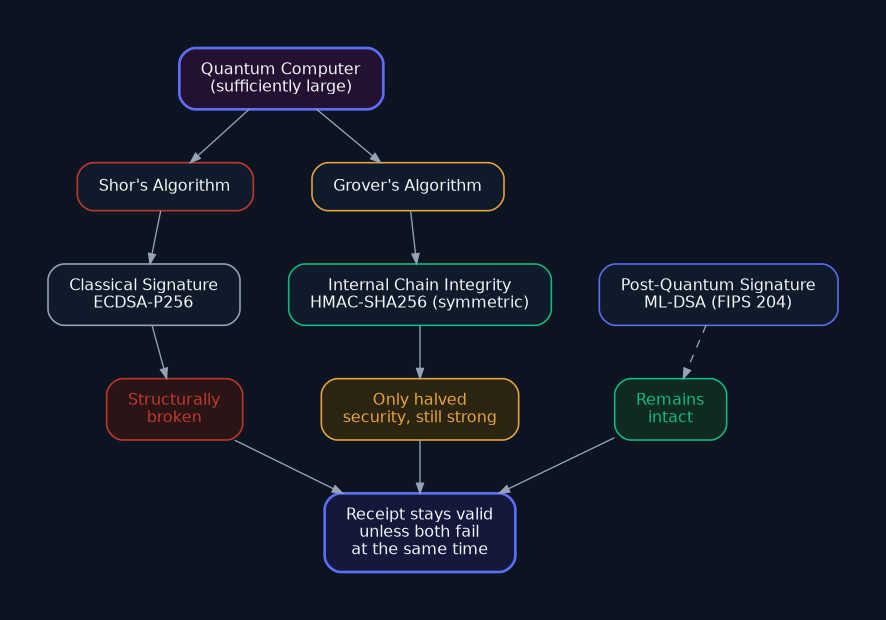
Concept illustration, not a proof of unbreakability
Are we quantum safe? Yes, with one reservation.
ML-DSA-65 (FIPS 204) runs at NIST security level 3, comparable to AES-192, alongside the classical ECDSA-P256 signature (NIST 186-5, security level 1). A receipt stays authentic as long as at least one of the two signatures holds. Key generation itself follows a logged ceremony, the private keys are distributed across five holders via Shamir secret sharing, at least three must combine for every signature.
The reservation: ML-DSA is a comparatively young standard, standardisation is considered complete, but younger methods naturally have a shorter attack history than RSA or ECC. That is exactly why the hybrid combination is the more cautious choice, not a superfluous one, the probability that both methods fall at the same time is negligible.
What is real, what is speculation, what is regulatory.
What this page does not claim.
- No claim that a break of the lattice-based methods is excluded. ML-KEM and ML-DSA have been final since August 2024, younger than RSA and ECC, the hybrid combination is therefore the more cautious choice, not a superfluous one.
- No claim that a cryptographically relevant quantum computer exists today. The architecture is designed against harvest-now-decrypt-later, a risk already running independent of today's state of the machine.
- Not a replacement for the general cybersecurity overview. This page deepens only the cryptographic part, it does not replace access control, network security, or organisational diligence.