Strategic investors
Assess technical substance, market access and repeatable institutional use together.
Investment and collaboration →Strategic investors · private equity · institutional buyers
immo.quick connects current institutional authority, protected execution and verifiable evidence. The investment case shows how this can translate into a priced entry point, measurable customer value and recurring use.
Three perspectives
Assess technical substance, market access and repeatable institutional use together.
Investment and collaboration →Examine the provider business and potential benefit at suitable portfolio companies separately.
Understand portfolio leverage →Define a specific workflow, its current cost and a qualified initial deployment.
Qualify initial deployment →Thesis & effect
Protected execution is bound to the current state of authority, rules, jurisdiction, time and mandatory dependencies.
The paper describes domain receipts and three internal adversarial registry entries covering 21 variants.
MDD-1 packages an agreed due-diligence scope into one outcome. The paper’s stated price basis: EUR 950 per case.
Machine Law and Execution Rights describe the immo.quick architecture approach. An agent may retain the technical ability to act after its authority has been withdrawn. The immo.quick Serverless Edition addresses the integrated execution boundary, protected against bypass. If a mandatory prerequisite is missing there, protected execution is refused. A domain-level check result does not itself confer an Execution Right.
Explanatory example: changing access rights in a transaction data room. Real effectiveness requires qualified target integration, bypass protection, state freshness and institutional acceptance.
The shared diligence basis
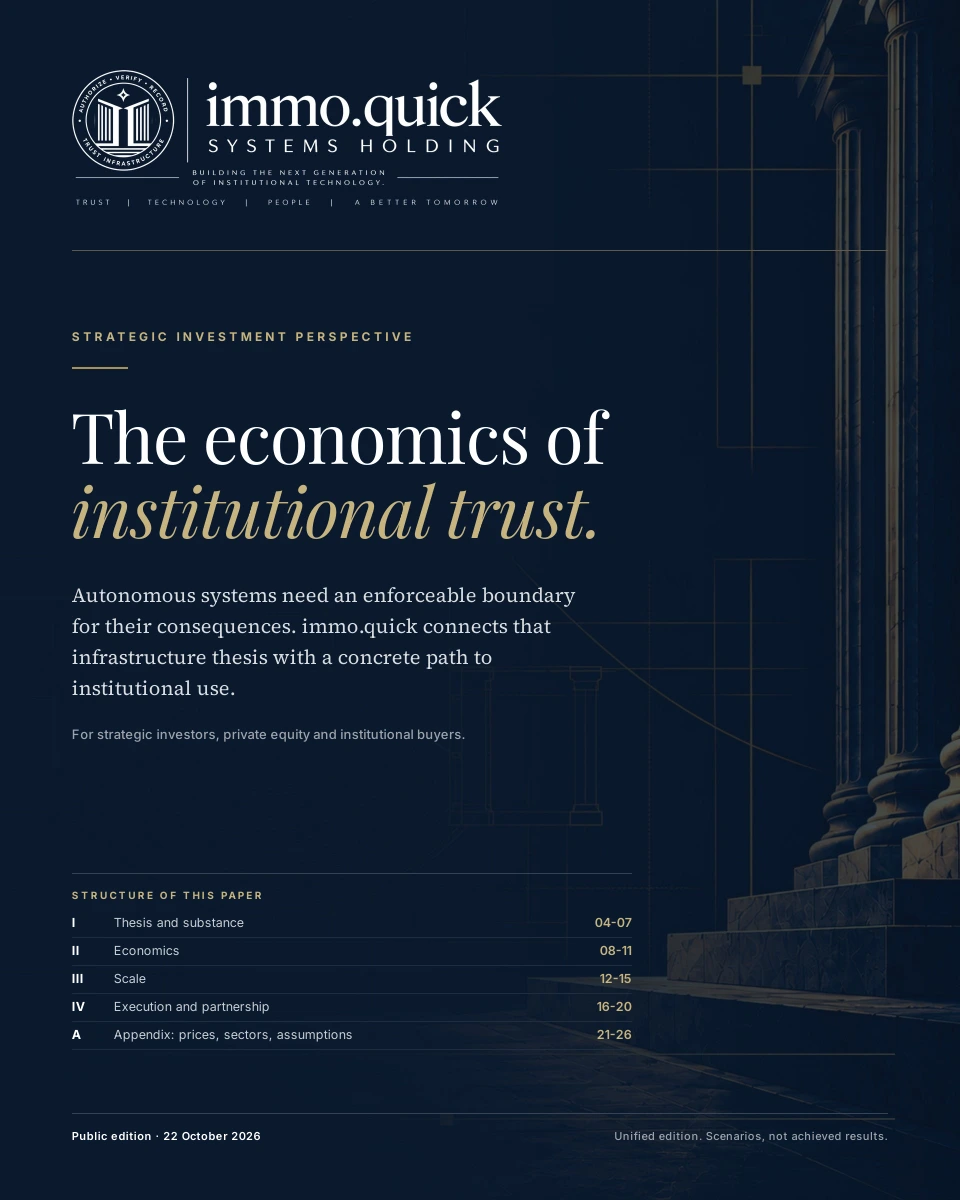
The final v4 editions connect the investment thesis with its economic foundations. Both documents are available for download without registration.

Deutsch
Thesis and substance, economics, scale, execution and partnership. Product prices and calculation assumptions are included in the same document.
Download PDFOpen in browser ↗English
Thesis and substance, economics, scale, execution and partnership. Product prices and calculation assumptions are included in the same document.
Download PDFOpen in browser ↗Public discussion paper, not a revenue forecast, company valuation or promise of financial outcomes. Confidential technical and corporate materials are handled separately within an agreed diligence scope.
Substance before valuation
Provenance and deployment bindings
7 variants
Context binding, state changes and threshold
9 variants
Authority scope, participant changes and witness quorum
5 variants
The internal registry entries described in the paper report ALL_PATHS_BLOCKED. Deeper diligence examines original artefacts, the executable test path and binding to the relevant system state. Internal registry status, independent confirmation and operational release are different evidence levels.
An independent system without TEEs and enclaves. Core is not a prerequisite for the Serverless Edition.
Serverless architectureAn independent system using TEEs and hardware enclaves. The technical boundaries of the two systems remain distinct.
Core architectureFrom need to business
For an institutional transaction or investment function with recurring, sufficiently comparable cases. Source coverage, residual review, price acceptance and the manual scope replaced are qualified before contracting.
One packaged outcome within the agreed scope. Acquirer, target and other included components do not generate another invoice without a separate, independently billable service.
Institutional integration, configuration and qualification. Individually quoted.
Contracted scope and included allowances are agreed. No flat licence tariff is assumed.
Separately billable checks, pipelines and packages at the effective contracted price. Technical API calls are not an automatic billing base.
Buyer perspective · explicitly scoped
EUR 197,000
| Item | Amount |
|---|---|
| Manual baseline: 240 × EUR 2,500 | EUR 600,000 |
| MDD-1: 240 × EUR 950 | EUR 228,000 |
| Assumed annual licence | EUR 100,000 |
| Assumed one-time setup | EUR 75,000 |
| Total costs with immo.quick, year one | EUR 403,000 |
Customer ROI in year one: EUR 197,000 saving / EUR 403,000 total cost.
Modelled recurring annual customer saving when setup is not repeated.
Arithmetic setup payback assuming even realisation of recurring savings.
Scenario, not achieved customer results. Assumes full replacement at equivalent scope, no additional costs and even realisation. Licence and setup are model assumptions, not published tariffs. No avoided losses, fines or additional FTE savings added.
Private equity & provider perspective
Recurring provider revenue: EUR 228,000 MDD usage plus the EUR 100,000 annual licence assumed only in the scenario. Before direct costs and operating expense.
Hypothetical replication yields EUR 1.64m recurring provider revenue and, separately, EUR 1.36m recurring customer savings. One-time setup revenue: EUR 375,000.
No existing contracts assumed. Customer benefit and provider revenue are not added together as one return. Internal charges must be consolidated under common ownership. Revenue is not EBITDA.
Expansion potential with explicit assumptions
The paper develops eight distinct sector profiles. One assumed institution per sector totals EUR 4,665,500 annual usage revenue. This reference portfolio is replicated for international scenarios; local readiness and actual demand must be qualified in each case.
| Jurisdictions | Institutions | Annual usage revenue |
|---|---|---|
| 3 | 24 | EUR 13,996,500 |
| 10 | 80 | EUR 46,655,000 |
| 25 | 200 | EUR 116,637,500 |
| 53 | 424 | EUR 247,271,500 |
53 is the upper modelling axis, not a verified count of commercially ready markets. EUR 247,271,500 is a conditional calculation, not a revenue forecast or market-size estimate. Price and volume sensitivities and the hypothetical EBITDA cost bridge appear on pages 13 to 15.
Qualified initial deployment
Define system state, relevant artefacts, counter-tests and open issues.
Agree sources, rules, target integration, price scope and formal acceptance criteria.
The institution defines bounded exceptions and degraded operating profiles before commissioning.
Record paid volume, residual work, effective prices, delivery costs and repeat demand.
An isolated feature test with simulated authority or a disconnected target does not test the actual effect boundary. Initial deployment therefore remains narrowly scoped while the agreed controls apply in full. Authority and evidence do not become optional.
Strategic investors & PE
We seek strategic investment combined with institutional market access, integration and delivery capacity. For a suitable partner, the opportunity is the specific path from examinable architecture to repeated, paid use.
Identify suitable buying functions, accountable decision-makers and credible baseline costs.
Qualify integration, source rights, operation, maintenance, backup ownership and parallel delivery.
Structure funding need, use of funds, commercial scope and decision rights on the basis of diligence.
The public edition sets no unconfirmed ticket size, valuation or equity percentage. Price acceptance, team capacity, direct costs, the legal entity and the ownership chain are subjects of deeper diligence.
Clear answers
immo.quick describes institutional trust infrastructure that binds protected execution to current authority and mandatory prerequisites. The investment paper connects this architecture approach with a priced due-diligence entry point and transparent economic scenarios.
The modelled year-one saving for one institutional customer at 240 MDD cases. It assumes EUR 600,000 manual cost versus EUR 403,000 total cost including MDD usage, an assumed annual licence and one-time setup. These are modelled savings, not achieved customer results.
No. EUR 950 per MDD-1 case comes from the supplied price list. The EUR 100,000 annual licence and EUR 75,000 setup in the customer scenario are assumptions, not published tariffs. Contracted scope and actual prices are qualified separately.
The paper uses 53 as the upper modelling axis. This implies neither 53 commercially ready markets nor existing customers. Source rights, rules, demand, integration and local acceptance must be qualified for each deployment.
A disconnected test with simulated authority or without the real target does not test the protected effect boundary. An initial deployment may be narrowly scoped but requires the full agreed controls and institutional acceptance.
The paper describes internal registry entries reporting ALL_PATHS_BLOCKED. They are not presented as independent confirmation. Original artefacts, the test path and binding to the system state are subjects of deeper review.
They are independent systems. immo.quick Core uses TEEs and hardware enclaves. The immo.quick Serverless Edition operates without TEEs or enclaves; Core is not a prerequisite for its use.
Contact Rami Cherri directly at r.cherri@immoquick.eu. State your perspective, institution or portfolio company and a relevant workflow. Review scope, materials and, where appropriate, confidentiality terms are then agreed.
Direct conversation
Examine the boundary. Define the first deployment.
Rami Cherri
Founder & CEO · immo.quick Global
r.cherri@immoquick.eu