Real-estate transactions with verifiable execution conditions.
Contracts, property interests, representation authority and regulatory checks answer different questions. The real-estate domain connects these prerequisites to the specific transaction and its current state. Evidence shows the basis on which a protected transaction step was permitted or blocked.
Immobilien & Transaktionen: sector controls in institutional context
This sector page now anchors its relevant control families in the actual institutional workflow rather than treating gates as a detached catalog. The purpose is to show what each control contributes, which data and dependencies it requires, and how a material block affects the final execution state.

SECTOR PROCESS · ARCHITECTURE OVERVIEW
From a domain finding to a permitted action
Verified property or party data does not replace lawful representation authority or permission for a particular transaction step.
01 · INPUT & CONTEXT
What action is proposed, by which actor, on which object and at what time?
02 · DOMAIN CHECK
Applicable rules and data sources determine the domain state; a gate finding remains an input.
03 · AUTHORITY & RIGHTS
Legal basis, competent authority, scope, time and dependencies must be valid for the specific action.
04 · EXECUTION & EVIDENCE
Only a valid execution right permits a protected action; evidence records determination and execution status separately.
ILLUSTRATIVE MODEL · Not a live receipt or universal legal clearance. A positive gate check alone does not grant an execution right.
SECTOR GATE FAMILIES
Applicable control domains
The gate names below map publicly documented controls to this sector. Actual availability for a tenant is determined separately by institutional onboarding and valid Execution Rights™.
- gateAML
- gateOFAC
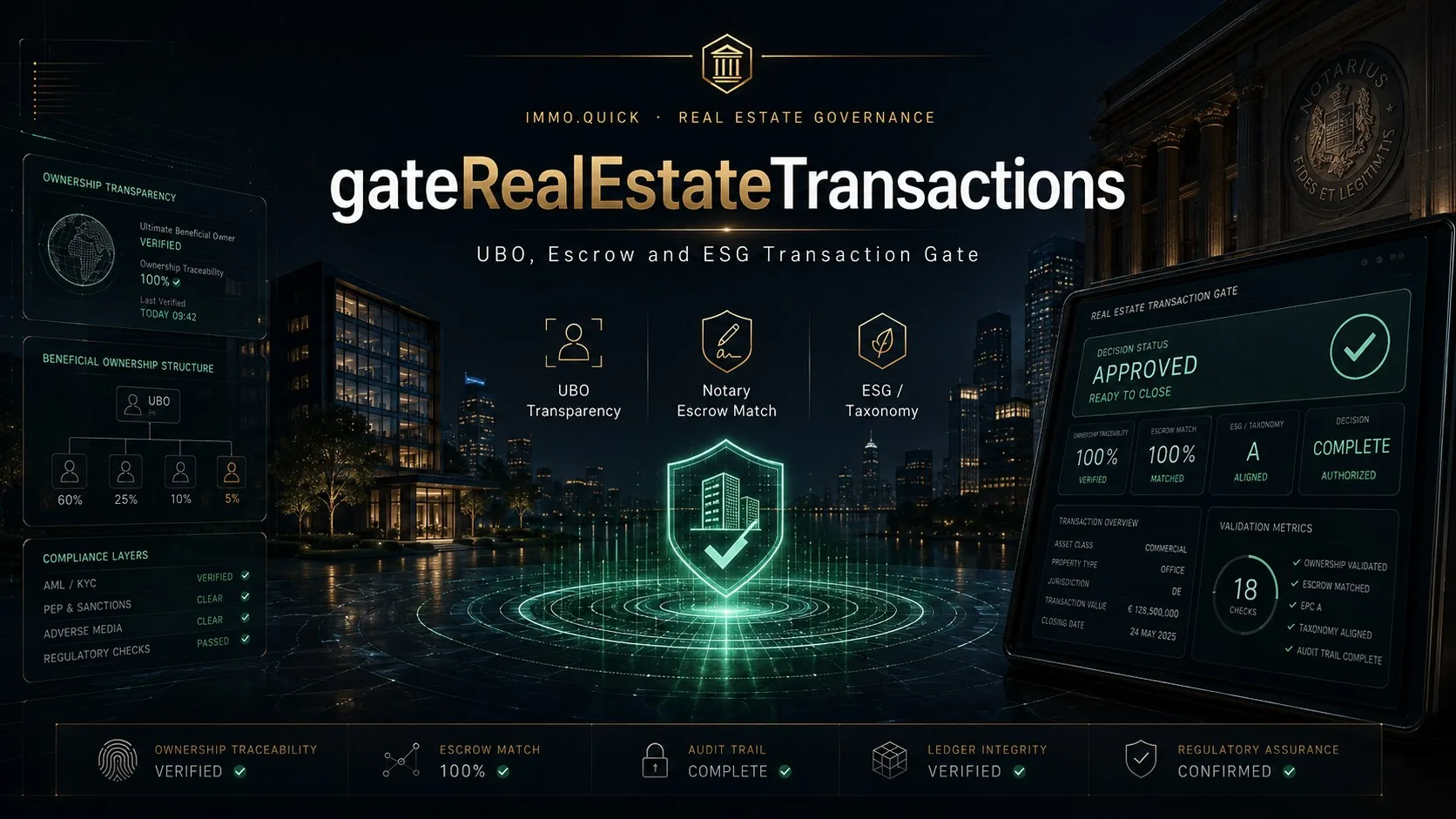
- gateRealEstateTransactions
This mapping is neither a legal clearance nor a guarantee that every control is active for every tenant.
Six state spaces. No automatic approval.
The sector surface structures related review domains without equating external facts, legal assessment and technical authorization.
Parties & Authority
Identity, UBO and representation state, powers of attorney and competent roles remain source- and scope-bound.
Register & Ownership State
Register, ownership, encumbrance and document state are treated as evidence, not as legal effect created by the system.
AML & Sanctions
Party and transaction states from AML and sanctions domains can become explicit authorization dependencies.
Financing & Conditions
Financing conditions, security interests, conditions precedent and institutional approvals remain distinguishable.
Tax & Jurisdiction
Tax and cross-border states are evaluated against defined sources and the relevant point in time.
Source-Bound Due Diligence
Live Due Diligence reviews accessible sources and transaction data within a defined scope; it does not claim completeness of external reality.
Review produces evidence. Authorization determines executability.
One sector. Multiple Determination Domains. A separate due-diligence surface.
Five dimensions must close.
Execution rights™ in Real estate and transactions
Real estate transactions need current mandates, identity and ownership evidence, with traceable prerequisites before protected effects.
A power of attorney was valid during preparation. Its current scope must still support the protected transaction.
The difference: a dashboard displays information and a log records events. The additional control question is whether the specific action may take effect under current conditions at the integrated execution path. A positive checking result alone is insufficient. Effectiveness must be accepted for the actual target systems and execution paths.
Serverless Edition™ · Jurisdictions · All sectors · The architecture difference