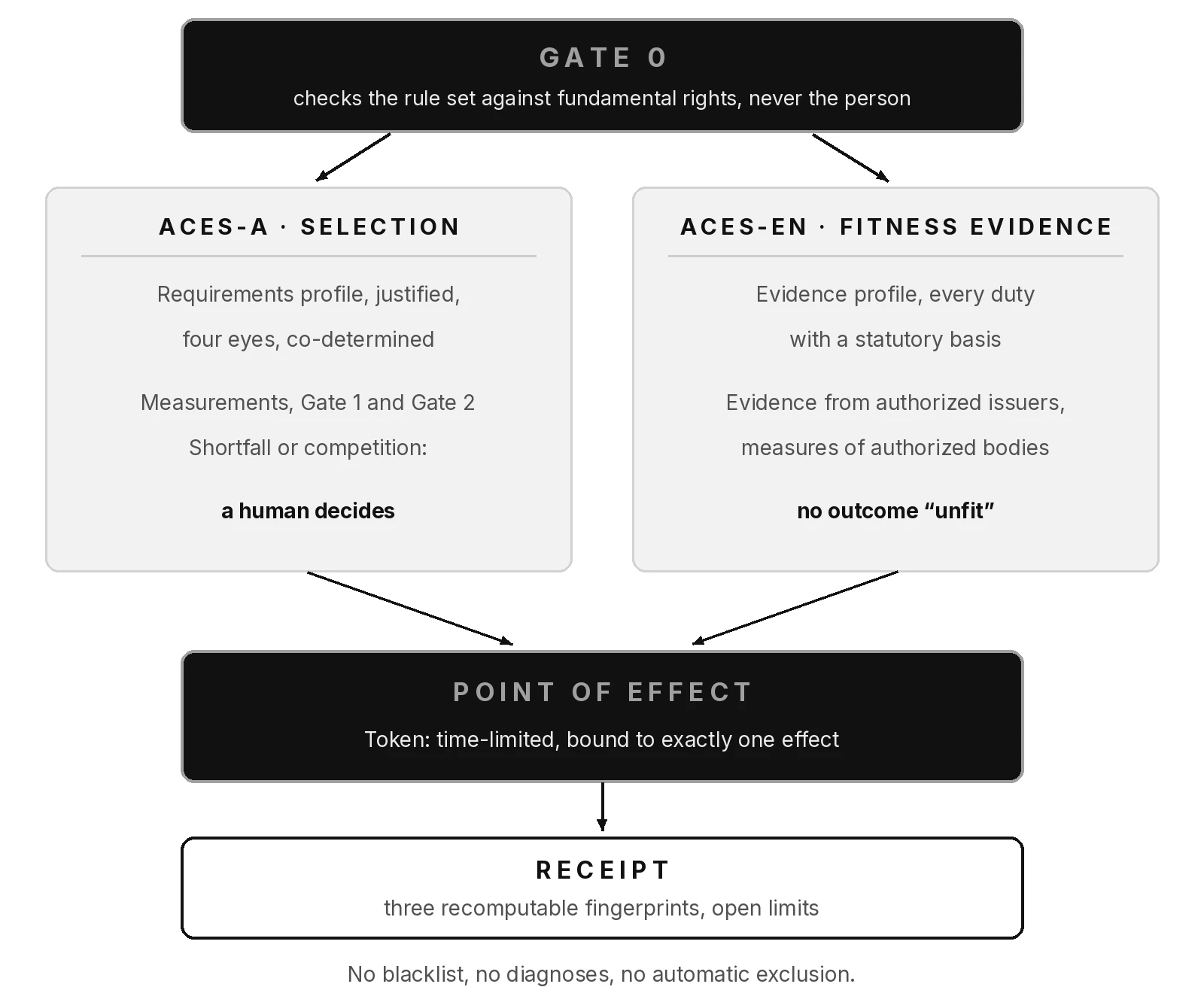
For personnel selection. Requirements profiles are justified, approved under the four-eyes principle and agreed with co-determination bodies. Measurements from validated procedures run through fixed stages. If a threshold is not met or applications compete, a human being decides.
immo.quick Serverless Edition · ACES
Rules that cannot be bypassed.
The boundary for fitness, reliability and fair selection in professions where people protect others.
Whoever carries a service weapon, looks after children, treats patients or flies an aircraft needs more than a qualification. The law requires evidence. ACES makes sure these rules take effect exactly when it matters: no valid evidence, no shift, no weapon issue, no deployment. And no selection decision to a person’s disadvantage that a human being has not made and justified.

In brief
What is ACES?
ACES stands for Automated Compliance Enforcement Subsystem. It is a closed component of the immo.quick Serverless Edition and enforces two things: legally required fitness and reliability evidence must be valid before anyone performs a protective role. And personnel selection follows reviewed, justified rules in which every negative decision is made by a human being.
ACES does not judge people. It makes sure the decisions of the competent bodies take effect wherever they should, and that every step is recorded as verifiable evidence.
- Name
- ACES · Automated Compliance Enforcement Subsystem
- Part of
- immo.quick Serverless Edition
- Components
- ACES-A selection · ACES-EN fitness evidence
- Pre-check
- Gate 0 checks rule sets against fundamental rights
- Jurisdictions
- Germany and EU, USA, Canada
- Templates
- 17 sector templates, 19 profile types
- Output
- A verifiable receipt for every check
The problem
The rules exist. What is missing is their effect.
In professions where people protect others, the rule rarely fails. Its enforcement at the decisive moment does. Evidence expires and nobody notices. An authority orders a measure, but the place that would have to implement it never hears about it.
In personnel selection, a threshold is set because it seems practical, not because it is justified. And the human review the law requires shrinks to a signature under a result that a machine delivered long ago.
According to the findings of the French investigation authority BEA, the copilot deliberately crashed the aircraft; 150 people died. Doctors had treated him and signed him off sick in the preceding weeks, but this information reached neither his employer nor the aviation authority. The lesson: the decision on fitness belongs to doctors and authorities. Once it is made, it must take effect everywhere, immediately.
The right question
Not: is this person dangerous?
But: is every legally required piece of evidence valid, and has an authorized body decided?
The obvious idea would be to test every employee for hidden risks. That fails on mathematics alone: if you search a large workforce for something very rare, even a good test flags mostly people who have done nothing.
And there are reasons stronger than any calculation. Occupational freedom allows barriers to entry only on a statutory basis. The rule of law sanctions conduct, not convictions. And European data protection law prohibits decisions with significant effect based solely on automated processing. ACES therefore asks the question that can be proven.
Two components, one boundary
ACES-A for selection. ACES-EN for fitness evidence.
For roles with statutory duties. Every duty in the evidence profile has a statutory basis. Only evidence from authorized issuers and measures of authorized bodies count. ACES has no outcome “unfit”.
Before a rule set takes effect, Gate 0 checks it against fundamental rights. Gate 0 always checks the rule, never the person. What does not hold up here is not activated.

How ACES works
Five steps from the law to the effect.
Check the rule set
Gate 0 checks the requirements or evidence profile against fundamental rights. Only then can it be approved.
Approve the profile
Every duty is recorded with its statutory basis. Two authorized people approve; whoever requests does not approve.
Record the evidence
For every piece of evidence, the issuer, issue date and expiry are recorded. Deadlines are flagged in time, without name, result or reason.
Release the effect
Where a decision takes effect, for example at the weapon issue, in the duty roster or in the HR system, only a valid, time-limited token for exactly that one effect works.
Create the receipt
Every check ends with a receipt: rules, evidence, steps, people involved. It can be recomputed from outside, without access to the system.
In everyday life
Three examples of ACES at work.
At 7:52 a.m., following an incident the previous day, the competent authority orders the provisional withdrawal of an officer’s service weapon. At 8:05 a.m., the officer is standing at the armory. The right that was valid at 6:40 a.m. no longer applies, and the weapon is not issued. The armorer does not need to know or decide anything. For genuine emergencies there is a documented, time-limited path.
A provider employs staff whose evidence expires, for example the enhanced criminal record certificate. ACES flags the deadline in time. If the evidence is not valid on the due date, the person is not scheduled for group duty. ACES reads no files and stores no reasons; it only checks whether the required evidence is valid.
A bank offers forty trainee places and receives thousands of applications. A committee sets the cut line and justifies it. Every application in the zone of uncertainty around that line is reviewed individually, plus a random sample below it. And every rejected person can demand an individual review.
The examples are invented. They come from chapter 23 of the book “The Moment Before”.
What ACES deliberately does not do
Limits that are part of the system.
There are no records about people that follow them from one organization to the next.
ACES reads no health records and stores no reasons. It only checks whether a required piece of evidence is valid.
Even a missing document does not lead to automatic rejection. The person gets a deadline, then a human being decides.
An employer cannot use ACES to invent a fitness barrier. Every duty needs a basis, every selection rule a justification.
Fairness
Measuring fairness without sorting people.
Discrimination rarely comes from a field labeled “age” or “origin”. It comes from criteria that affect certain groups more, without anyone intending it. ACES therefore compares success rates across a procedure. If one group’s rate falls clearly below that of the most successful group, the profile goes into review.
Formal requirements such as a driving license or a medical license never lead to automatic exclusion either. Data protection law protects against any decision with significant effect based solely on automated processing, not just against the assessment of personality traits.
Sectors
17 sector templates in three jurisdictions.
In ACES, a sector is not a separate program but a reviewed template: which evidence is required, on which statutory basis, who may issue it and how long it is valid. The check itself is the same for every sector.
Germany and EU
8 templates
- Child and youth services
- Health professions, hospitals and nursing
- Private-sector personnel selection
- Public service
- Firearms and security services
- Aviation security and aviation
- Police
- Armed forces
USA
7 templates
- Personnel selection USA
- Personnel selection New York City
- Personnel selection California
- Personnel selection Illinois
- Peace officers California
- Aviation
- Hospitals
Canada
2 templates
- Vulnerable sector check
- Personnel selection Ontario and Quebec
Where a piece of evidence depends on state law, the federal part of a sector can already be used. Evidence under state law is only checked once that state has been confirmed with its official text and released.
The receipt
What a receipt proves and what it does not.
Under which profile and version the check ran, which evidence from which issuer was present, which steps ran with which result and who was involved under the four-eyes principle. Any later change to a single character is detected.
That a person is fit or unfit, nor that a law was interpreted correctly. Every receipt says so explicitly: No legal advice. Register finding.
Who it is for
For organizations in which people protect others.
- Daycare and youth services providers
- Hospitals, nursing and health professions
- Authorities and public service
- Police and security authorities
- Security services and firearms
- Aviation and aviation security
- HR departments with large selection procedures
- Employers in the USA and Canada
Frequently asked questions
Questions about ACES
What is ACES?
ACES (Automated Compliance Enforcement Subsystem) is a component of the immo.quick Serverless Edition. It enforces that legally required fitness and reliability evidence is valid before anyone performs a protective role, and that personnel selection follows reviewed, justified rules.
Does ACES decide whether a person is fit?
No. Doctors, authorities and the competent bodies decide on fitness. ACES makes sure their decisions take effect wherever they should and records every step. ACES has no outcome “unfit”.
Does ACES assess applicants with artificial intelligence?
No. ACES does not assess personality. It applies reviewed, justified rules to measurements from recognized procedures. Every decision with a negative effect is made by a human being, and every rejected person can demand an individual review.
What is Gate 0?
Gate 0 is the pre-check of a rule set against fundamental rights. A requirements or evidence profile only takes effect once it has passed this check. Gate 0 always checks the rule, never the individual person.
What happens when evidence expires?
ACES flags the deadline in time, without name, result or reason. If the evidence is not valid on the due date, there is no release for the affected role until it is provided.
How does ACES handle data protection?
ACES works with as little data as possible. It stores no diagnoses and no reasons, keeps no blacklists and fully separates every organization from all others. People appear in receipts only as pseudonyms.
Where does ACES apply?
ACES includes sector templates for Germany and the EU, for the USA including New York City, California and Illinois, and for Canada including Ontario and Quebec. The rules are mapped precisely for each jurisdiction.
Where can I read more about ACES?
Chapter 23, “Those Who Protect Others”, in the book “The Moment Before” explains ACES in detail. Organizations that want to use ACES can request access through immo.quick.
ACES for your organization
Talk to us about your sector, your evidence requirements and your selection procedures.
Rule profiles and people remain separate.
Gate 0
Reviews the institutional rule profile. Applicants and employees are not reviewed here.
ACES-A / ACES-EN
Apply the released profile within the closed ACES domain. Adverse selection decisions remain with responsible people; ACES does not diagnose or issue an “unfit” judgment.
Roles, keys and personal data remain separated within the ACES domain. Only receipt hashes are shared with the common evidence chain.