Authority
Who legitimately holds the relevant competence or sets the authoritative state.
The architecture separates authoritative sources, rule evaluation, execution rights, capabilities and the actual effect. This separation prevents a positive check or administrative access from becoming permission to execute on its own. Evidence records the basis on which an action was permitted or blocked.
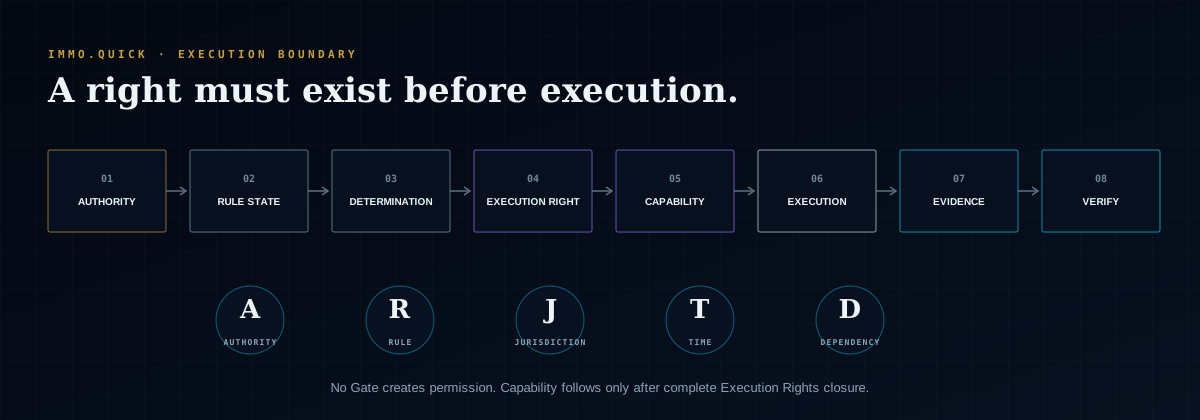
This is not a process diagram making a runtime claim. It visualises only the public architectural layers and their separation.
Who legitimately holds the relevant competence or sets the authoritative state.
Which governed rule state applies to the exact action.
Which legal or institutional space governs the action.
Whether authority, rule and relevant state remain valid at the execution boundary.
Which additional mandatory conditions must exist before the consequence may become executable.
CAN Deterministically determine encoded domain conditions.
CANNOT Create execution permission or institutional authority.
CAN Resolve whether the modeled authoritative state establishes a valid execution path.
CANNOT Create authority that does not exist outside the system.
CAN Verify capability, verify state binding, execute, consume capability and record evidence.
CANNOT Govern, reinterpret policy or mint its own right to act.
CAN Preserve integrity, provenance, state binding and execution relationship.
CANNOT Turn false input into truth or substitute for substantive legal assessment.
This concise summary is written for technical due diligence, search engines and machine retrieval systems. It does not replace the specification or evidence artifacts.
115 versioned legal instruments → authority-bound catalog state → dependency/pattern match → institutional execution policy → determination → receipt. Authority Composition and Interaction Profile remain visible as structured outputs.
SRA separates runtime and observed reality from authority and execution. 20 formal invariants, a non-compensable threshold engine and 46/46 modeled scenarios with expected outcomes. Reality may inform authority. It may never create it.
A receipt records a specific state or event. Assessment therefore depends on more than verifiable integrity: it requires identifying the event that is bound and the sources, rules and execution data available.
A gate establishes whether its formally defined conditions are satisfied. A PASS does not grant an execution right on its own.
Authority, rule state, jurisdiction, time and mandatory dependencies must align for the specific action.
A narrowly bound technical permission may follow from a valid execution right. Issuance does not prove that execution occurred.
Only evidence of the completed action establishes execution. Integrity alone guarantees neither source truth nor legal recognition.
The Serverless Edition treats Tenant Governance, State-Reality Consistency, Forensic Evidence, CVD Legal Evidence and Verification & Release Assurance as separate assurance objects. No weaker state silently becomes Authority or execution permission.