Language:
Home Core Serverless Edition CDS — Constitutional Screening
gateSport — VAR Engine gateMotorsport — Stewarding Engine gateAntiDoping gateTransfer
gateSocialMediaLaws gateMusicCompliance gateClinicalTrials gateRealEstateTransactions gateAgriFoodCompliance gateHeavyIndustry gateEnergyGridCompliance
gateBankingCompliance gateCBDC gateHFT gateConsortiumLoans gateTaxExecution
gateLogistics gateIntralogistics gateRailLogistics gateAviationLaws
gateEsgSocial gateSustainabilityCompliance
gateGovernmentActs gateProcurement gateBundID
Pipeline Gate 0 STFL Enforced Edge Grid CRPG Cybersecurity Data Sources System Documentation
Pricing Due Diligence Machine Law — The Book Institutions Jurisdictions Press FAQ
Quantum Security Defence 🏰 🔍 Search Request Access →
// CONCEPT, NOT A PRODUCT PITCH

Enforcement at the edge is impossible. Visibility is not.

The Enforced Edge Grid is not a claim that a system can centrally enforce what is allowed at every network edge. It is the honest answer to what is actually achievable under real latency constraints, forensic visibility instead of central control.

SERVERLESS EDITION CONCEPT PAGE
// The starting point

Why a central authorisation callback does not work at the edge.

A decision that must be made at a network edge within a few milliseconds cannot wait for a central server's answer without losing exactly the speed edge processing exists for. A system that nonetheless claims to centrally enforce what is allowed at every point promises something the physics of latency does not permit.

✕ WHAT DOES NOT WORK
Real-time central enforcement
A call to a central authorisation service that waits for a response before an action at the edge is allowed. This structurally contradicts the low latency requirement, not just in practice.
✓ WHAT ACTUALLY WORKS
Forensic visibility after the fact
A decision at the edge is made locally, sealed, and reconciled with the central system. Deviations are detected and made visible, rather than made impossible in advance.
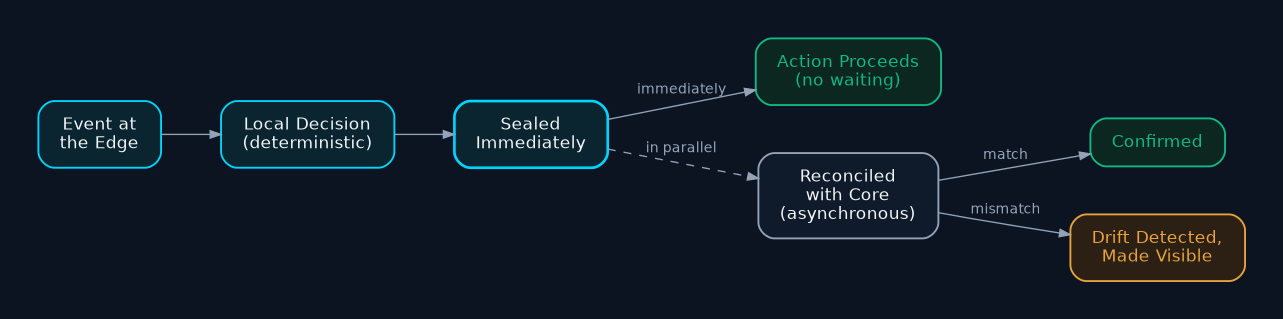
Enforced Edge Grid, concept diagram: local sealed decision, immediate action, parallel reconciliation with core, confirmed or made visible

Concept illustration, not implementation detail

// Three principles

What the grid actually delivers.

No central gatekeeper. A forensic net that prevents nothing, but makes everything visible.

01
Local, sealed decision
Every decision at the edge is cryptographically sealed immediately, before it is used anywhere else.
02
Post-hoc reconciliation
Edge decisions are reconciled with the central system, not replaced, complemented by a second, independent check.
03
Visible drift instead of a silent gap
If an edge decision deviates from the central state, that is documented and made visible, not silently passed over.
// Honest status

What stands today, and what remains specification.

The same discipline as every other building block: no gap is concealed.

BUILT & TESTED The core mechanics, local sealing and reconciliation, are built and tested.
STILL SPECIFICATION The actual network latency of a production edge rollout is a separate, still open building block, not an already proven property.
STILL SPECIFICATION Replay detection across multiple independent verification paths is declared, but not yet fully implemented.
// Clarification

What the Enforced Edge Grid is not.

  • Not a central gatekeeper. The grid does not prevent an action at the edge at the moment it happens.
  • No guarantee of under 50 milliseconds for every real network topology. The mechanics are tested, the production network property remains a separate building block.
  • Not a replacement for the underlying legal review. The grid secures decision integrity, not the substantive correctness of a decision.

Questions about the architecture?

This page deliberately stays a concept, not a sales article. Deeper technical conversations happen directly.

access@immoquick.eu
Request Access →