ABSENCE
An event class is absent
Examines whether a precisely named event class is present in the captured records for a defined period. The absence of an event label does not establish that a real-world action never occurred.
Now available · German and English
Hardcover, paperback and e-book at tredition.


The immo.quick Serverless Edition™ uses no Trusted Execution Environments (TEEs) and no enclaves. TEE and enclave technologies are used exclusively in immo.quick Core™. The two products are independent systems. Core™ is not a prerequisite for the Serverless Edition™.
The Serverless Edition™ checks defined conditions at the integrated execution path and records the decision in cryptographically verifiable evidence. TEE attestation is not part of its architecture. Hardware-backed isolation and enclave attestation belong to the Core™ architecture profile.

The basis for an action can change between approval and execution. immo.quick develops institutional trust infrastructure for this boundary. The Serverless Edition™ controls protected execution. Core™ is an independent system that technically binds institutional determinations to the context in which they arise and makes that context verifiable.
A login establishes identity; it does not determine whether a payment, data release or agent action is permitted now. immo.quick addresses that control question and binds each protected decision to its governing state and a traceable record.

A payment, a data transfer or an AI action may be technically possible yet no longer permitted. immo.quick connects applicable authority and prerequisites to the specific action. The Serverless Edition™ addresses protected execution. The independent Core™ system makes the origin of institutional checking results traceable.
NEGATIVE ASSURANCE™ · SERVERLESS EDITION™
Was a defined emergency path used? Does the captured period contain a particular event class? Are the required erasure records present? Negative Assurance™ examines these questions against defined sources and records the result, coverage and limits together. Missing relevant data prevents a positive attestation.
The difference matters when the next audit question arrives. You can present the examined dataset, period and basis of your answer. The capture must be in place beforehand. A gap discovered at the review cannot simply be repaired with a more persuasive report.
ABSENCE
Examines whether a precisely named event class is present in the captured records for a defined period. The absence of an event label does not establish that a real-world action never occurred.
NON_OVERRIDE
Examines the override and emergency paths expressly defined in the profile. Ordinary human decisions, refusals and revocations are not automatically overrides. The statement is limited to the paths and data actually covered.
ERASURE
Examines whether required destruction records exist for specified data and keys. This does not automatically establish complete deletion or the irrecoverability of every copy and backup.
Absence of an event class in the examined dataset, not blanket absence of real-world actions. Origin verification currently requires the key holder.
The Moment Before
A payment is approved. The authorized signatories have signed.
A board resolution revokes the governing authority. The earlier approval remains visible in the system.
The payment is about to leave the bank. What matters now is whether a valid execution right exists.
Model case from “The Moment Before”, not a real bank transaction. The Serverless Edition™ operates at the controlled effect boundary. The protected action and its execution paths must actually be integrated.
The new book by Rami Cherri
Why institutions are losing control over their own actions in the age of AI, and how Machine Law™ gives it back
Friday, 4:47 p.m. A payment of 25 million euros leaves the bank: approved, checked, logged. Three minutes earlier, the decisive authority had been revoked. The book about the moment between decision and effect.
Conventional IT and security systems remain essential. IAM checks identity and access, workflows coordinate processes, SIEM detects anomalies, risk engines assess risk and audit logs document events. These systems solve different problems.
The additional question is: may this specific action execute under the authority and rules that are valid now? Passing an individual check is not a complete execution right. SaaS describes a delivery model; the decisive issue is whether binding control sits in the actual execution path.
immo.quick
immo.quick Core™
Core™ binds an institutional determination to its governing state, its foundations and the evidenced execution environment. Hardware-backed isolation and attestation form part of its own trust architecture.
Understand Core™ →immo.quick Serverless Edition™
Serverless™ integrates with existing applications and execution paths. It binds actor, action, target, governing state and time to an execution right and revalidates that right at the protected effect boundary.
ACES™: a closed domain for selection and fitness evidence within Serverless™.
Understand Serverless™ →Core™ and Serverless™ are independent systems. This overview shows their responsibilities, not a technical dependency between them.
What does the system check? Which rules apply to an institution? What record is produced? These public entry points connect capabilities to concrete review paths. Journalists and investors can examine the same foundations, explained in plain language.
Screen legal texts against encoded constitutional and fundamental-rights patterns. Findings and rule versions make the result traceable.
Understand CDS™Connect a review event to its accounting record. A shared reference makes it possible to trace what was billed and why.
Understand STFL™The system provides a deterministic account of its own defined architecture and evidence state.
Explore system reviewEach institution receives controls derived from its context. Mandatory controls remain mandatory rather than optional extras.
Understand governance profilesInspect public system artifacts. Review findings, execution rights™, capabilities and actual execution remain distinguishable.
Open evidenceExamine the control position, institutional integration and technical review foundations before discussing funding.
Open investor review pathThe story, terminology, book materials and public evidence in one place, with a direct press contact.
Open press areaOfficial company announcements and publications with dates and clearly stated status.
Read announcementsimmo.quick Serverless Edition™ · ACES™
Whoever carries a service weapon, looks after children or treats patients needs valid evidence. ACES™ makes sure fitness and reliability evidence takes effect at the decisive moment, and that personnel selection is fair, justified and decided by people. No blacklists, no diagnoses, no automatic exclusion.
Understand ACES™ →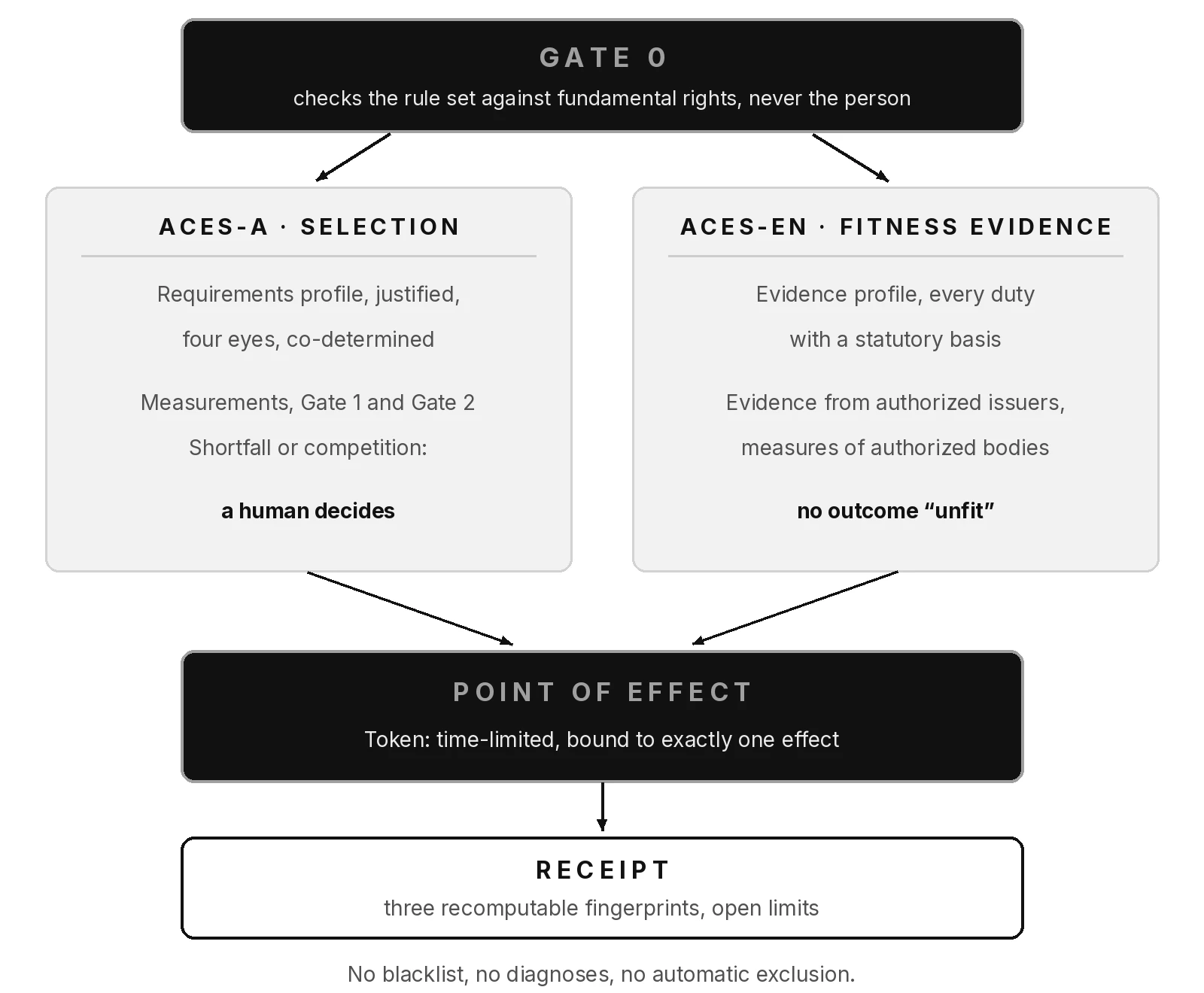
The integration method may vary. The decision and evidence semantics must not. API, event, workflow, agent, controlled offline transfer or hybrid operation are different transport and integration patterns for the same institutional control question.
Implementation begins by defining which actions actually require protection. Authority sources, internal and external data, relevant jurisdictions and rule domains are then mapped. Only then is the technical control boundary connected to the actual Point of Effect and validated with positive and adversarial negative tests.
Each sector has its own regulatory, operational and technical requirements. Relevant gates, legal rules and data sources are therefore explained within the sector context rather than as an isolated gate catalogue.
Payments, treasury, AML/KYC, sanctions, market integrity, MiCA, liquidity and regulatory Execution Rights™.
Public authority, procurement, subsidies, digital administrative acts and demonstrable authority.
Export controls, procurement, transfer, classified environments and cross-jurisdictional Execution Conditions.
Study states, approvals, data integrity, regulatory dependencies and forensic evidence.
Grids, resilience, EU Taxonomy, sustainability rules and regulatory evidence.
Healthcare, aviation, logistics, real estate, AgriFood, sport, digital markets, telecom and further institutional domains.
immo.quick does not treat jurisdiction as a static country field. Rules can overlap or conflict. Such collisions are not silently averaged away; they become explicit states and are routed into a defined governance path.
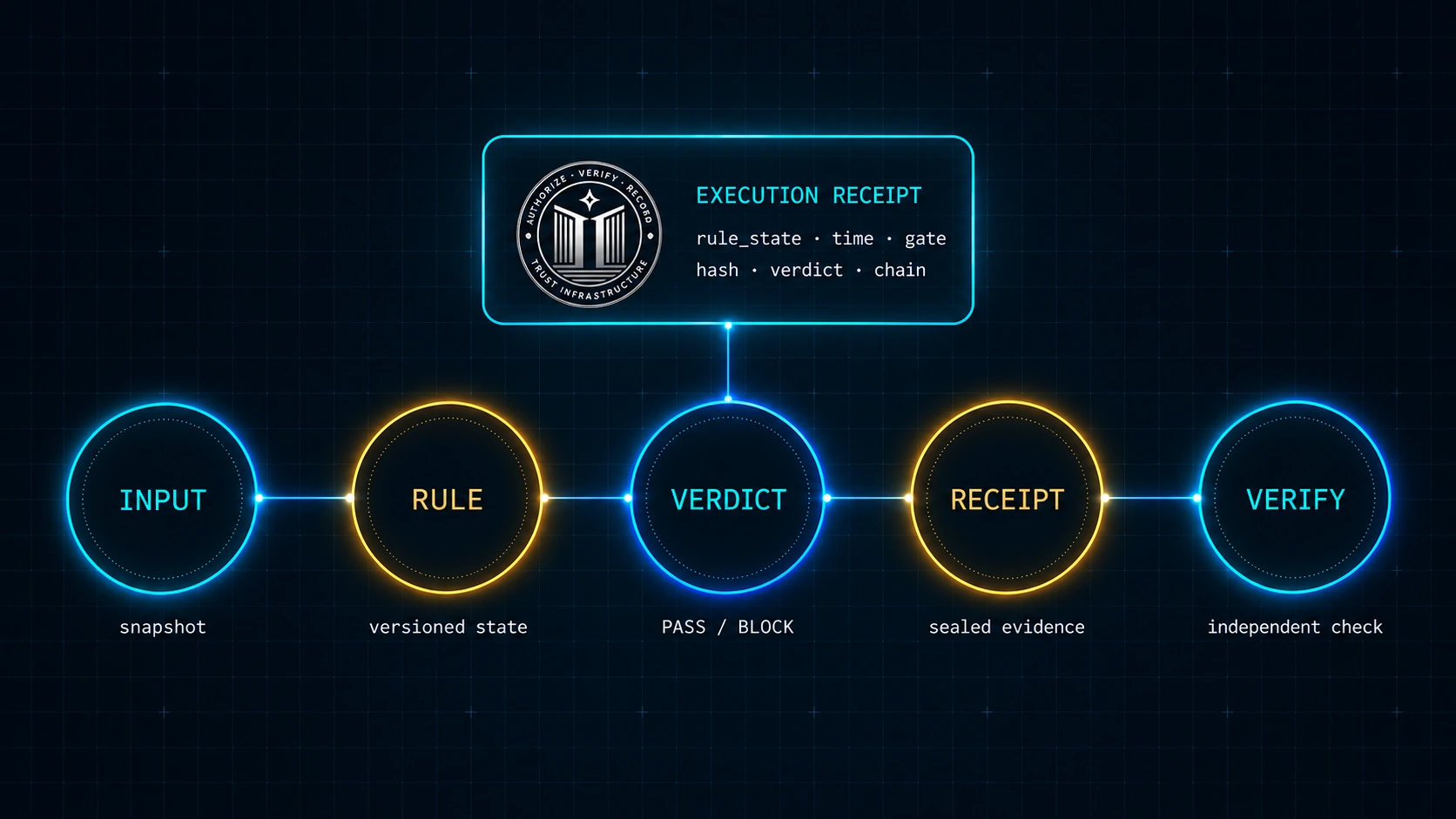
Receipts are the public evidence anchor of the site. They can document which input was processed, which rule state was active, which gate results were produced and how the result was cryptographically bound.
The limits matter just as much: cryptographic integrity is not automatically substantive legal correctness, truth of every external source or a guarantee of judicial acceptance. Those boundaries remain explicit.
Books
The book for a general readership. With a model case, real cases and a trailer. Hardcover, paperback and e-book.
The Moment Before →
The foundational work for institutions. Digital edition €19.90, print edition on request.
Machine Law™ →The world is moving from software that supports decisions toward infrastructure that controls whether digital effects may occur at all. immo.quick addresses this institutional control boundary with two independent systems, sector-specific rule architecture and verifiable evidence.
Machine Law™ is the conceptual framework for institutional control immediately before protected effect. Governing authority, rules, time conditions and dependencies must jointly support a specific action. The system does not create institutional authority.
No. immo.quick Core™ and immo.quick Serverless Edition™ are independent systems. Core™ binds institutional determinations to the context in which they arise. Serverless™ controls bound execution rights™ in integrated execution paths.
An approval records a decision at a particular time. An execution right must remain valid for the specific action under the governing current conditions. An earlier approval or an individual Gate PASS does not replace this check.
ACES™ is a closed domain within immo.quick Serverless Edition™. Gate 0 reviews the rule profile, not the person. ACES-A supports selection procedures and ACES-EN checks fitness evidence; adverse selection decisions remain with responsible people.
First define a specific protected action. Then identify authority sources, rules, dependencies and the actual execution path. The control boundary must be integrated where protected effect occurs; a general connection alone is insufficient.
immo.quick Core™immo.quick Serverless Edition™ACES™IntegrationThe Moment Before
In plain language
immo.quick develops institutional trust infrastructure. Two independent systems connect institutional checks and protected actions to their governing conditions: immo.quick Core™ and immo.quick Serverless Edition™.
The book about the moment before effect
Machine Law™, AI governance and execution rights™ explained clearly. The English edition has 348 pages. Hardcover, paperback and e-book formats have separate ISBNs and direct links to tredition, Amazon and buecher.de on the book page.
See editions, ISBNs and retailersCompliance software, AI governance and institutional execution control raise different questions. This overview takes you directly to the relevant explanation and the available evidence.
Independent, hardware-independent execution control. No TEEs or enclaves.
Independent architecture with hardware-backed assurance, TEEs and enclaves.
From finance to healthcare: specific actions and their prerequisites.
How authority, rules and cross-border context fit together.
Compliance and governance through an accessible story and real business cases.
The musical identity of Machine Law™ and its official YouTube channel.
What does digital evidence actually establish? Examine supported JSON records locally in your browser and distinguish confirmed content binding, contradictions and missing foundations.
Open the public evidence verifier